Last Updated: October 25, 2026
Quick Summary
Build your used car checklist before you contact the seller, then work through five stages in order: before contact, at the meeting, during inspection, test drive, and paperwork. Verify the seller’s ID matches the title and the VIN, pull a vehicle history report, and book an independent pre-purchase inspection before you hand over payment.
- A complete private-sale checklist covers five stages, and most buyers only build the middle two.
- Compare the seller’s driver’s license name to the title name exactly, including middle name and spelling.
- Tell the seller not to warm up the car, because a warm engine hides cold-start noises and smoke.
- Meet at the seller’s bank or a police station parking lot during daylight, with a second person if possible.
- Walk away from frame damage, flood evidence, odometer rollback, or undisclosed salvage titles.
Table of Contents
- Build Your Used Car Checklist Before You Contact a Seller
- Verify the Seller, Title, and Vehicle History First
- Questions to Ask When Buying a Used Car From a Private Seller
- Run a Used Car Test Drive Checklist That Exposes Problems
- Book a Used Car Pre-Purchase Inspection Before You Commit
- Complete the Used Car Title and Paperwork Checklist
- Interpret Inspection Findings and Decide Whether to Walk Away
- Order an Independent Inspection Before You Hand Over Payment
- Frequently Asked Questions
Build Your Used Car Checklist Before You Contact a Seller
A used car checklist is a written list of the checks, questions, and documents you work through before you hand over money for a private-sale vehicle. At Whyte Knyte Inspection, we build these lists for a living, and the biggest mistake we see is buyers who start texting sellers before they know what they need to confirm.
Build the list first. Then contact the seller, then inspect, then pay.
Consumer advice on buying a used car from a private seller
What Belongs on a Private-Sale Checklist
A complete private-sale checklist covers five stages, and each stage has its own jobs:
- Before contact: asking price research, title rules in your state, a saved list of seller questions
- At the meeting: seller identity check, title check, vehicle history report review
- During inspection: exterior, interior, tires, lights, fluids, warning lights, noises
Most buyers only build the middle two stages. The other three are where private sales go wrong.
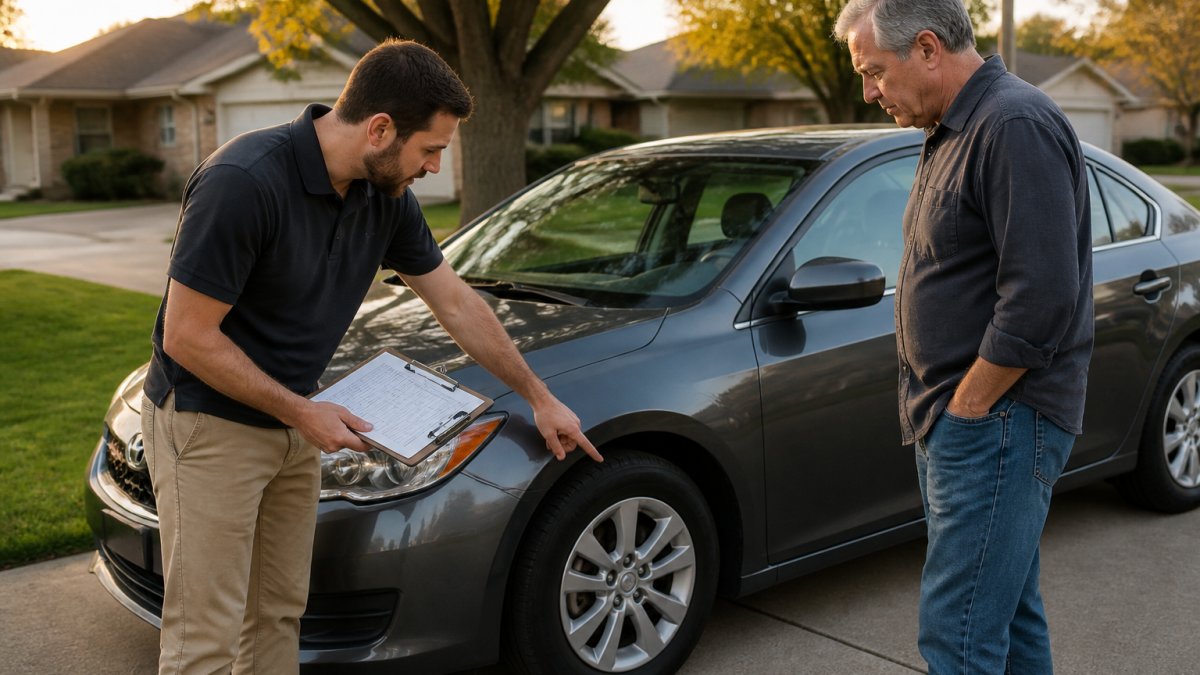
A complete private-sale checklist covers five stages, each with its own jobs.
| Stage | What to do |
|---|---|
| Before contact | Price research, state title rules, saved seller questions |
| At the meeting | Seller identity check, title check, history report review |
| During inspection | Exterior, interior, tires, lights, fluids, warning lights, noises |
| Test drive | Cold start, braking, steering, suspension, highway speeds |
| Paperwork | Bill of sale, title transfer, registration, payment method |
Verify the Seller, Title, and Vehicle History First
Verification comes before inspection. If the seller cannot prove they own the car, nothing else on the checklist matters. In a private sale there is no dealership backstop, so you are the entire compliance department.
Match the seller to the title
Ask for the seller’s driver’s license and compare the full legal name to the name printed on the front of the title. They should match exactly, middle name, suffix, spelling. Then check three more things:
- The VIN on the title matches the VIN on the dashboard and door jamb. A title that does not match the car is a stop sign, not a typo to work around.
- The title is in the seller’s name, not a relative’s, a friend’s, or a dealer’s. If the seller says they are “selling for a friend” or the title is in someone else’s name, treat that as a stop sign until the titled owner is present with ID or a signed, notarized power of attorney is in hand.
- The title is in hand, not “at the bank” or “in the mail.” A seller who cannot produce the title at the meeting cannot complete a clean transfer that day.
Read the title for liens and brands
Look at the title itself, not just the report:
- Clean title: no salvage or rebuilt branding, the normal case.
- Salvage title: the insurer declared the vehicle a total loss. It can be legal to buy, but insurance and resale value are affected, and some lenders will not finance it.
- Rebuilt title: repaired and re-titled after salvage. Ask for repair documentation and expect a lower price.
Never accept a title with a blank buyer section, white-out, or a seller who wants to “handle the transfer later.” Both leave you with no legal claim to the car.
Pull a vehicle history report and read it like an auditor
Order a report from a major provider and check four things, not just the accident count:
- Title brands, salvage, rebuilt, flood, lemon, or junk. These follow the car for life.
- Odometer readings over time, look for a reading that goes down, or a long gap between readings that hides mileage. Rollback is a stop sign.
- Owner count and geography, many owners in a short period, or a car that moved between flood-prone states, deserves a closer look.
- Open recalls, run the VIN through the National Highway Traffic Safety Administration’s recall lookup at nhtsa.gov/recalls. A report may lag; the federal lookup is the current source.
A report does not replace a physical inspection, but it exposes title brands, lien patterns, and rollback that a walkaround cannot. If the report and the seller’s story disagree, believe the report and ask the seller to explain the gap in writing.
VIN recall lookup from the National Highway Traffic Safety Administration
Questions to Ask When Buying a Used Car From a Private Seller
The right questions to ask when buying a used car from a private seller get you the maintenance records and the honest history before you spend a Saturday driving out to see it.
Send these in writing before you meet:
- How long have you owned the vehicle, and why are you selling it?
- Do you have service history and maintenance records?
- Has the car been in any accidents, and was insurance involved?
- Are there any open recalls, and have they been repaired?
- Does the check-engine light come on, and has it been scanned?
- Are there any known fluid leaks, noises, or warning lights?
- Is the title in your name, in hand, and free of liens?
- Has the odometer ever been replaced or repaired?
Vague answers to questions 3, 7, and 8 are the ones that end deals. Get them in writing.
Run a Used Car Test Drive Checklist That Exposes Problems
A used car test drive checklist works only if you drive the car cold. Tell the seller not to warm it up before you arrive. A warm engine hides cold-start noises, smoke, and rough idle.
Work through this sequence:
- Cold start: listen for rattles, watch for blue or white smoke, check that it idles smoothly
- Warning lights: confirm the check-engine light and others come on at key-on, then go out
- Low-speed lot drive: windows down, listen for brake noise, suspension clunks, and wheel bearing hum
Bring an OBD-II scanner. Plug it in and read diagnostic codes yourself, because a seller can clear a check-engine light right before you arrive.
Book a Used Car Pre-Purchase Inspection Before You Commit
A used car pre-purchase inspection is an independent mechanical evaluation of the vehicle, done by a professional who has no stake in the sale. It is the single highest-value step in the whole checklist.
Your test drive catches what a buyer can see and hear. If you are weighing the cost, read our guide on whether a pre-purchase inspection is worth it, then book a used car pre-purchase inspection with an inspector who travels to the vehicle.
At Whyte Knyte Inspection, our mobile inspectors go to the seller’s location and deliver a photo-documented report, with no financial interest in whether you buy.
Complete the Used Car Title and Paperwork Checklist
Paperwork closes the sale, and a used car title and paperwork checklist keeps the transfer clean. Rules vary by state, so confirm the specifics with your state motor vehicle agency before you sign anything. The sequence below is the private-sale workflow most buyers skip.
Before the meeting: prepare the paper trail
- Bill of sale: print two copies with both names, the VIN, the odometer reading, the sale price, the date, and signature lines for both parties. Both sign both copies; each keeps one.
- Odometer disclosure: required on the title or a separate federal form for most vehicles. Confirm which your state uses.
- Lien release: if the title shows a lender, get the release document before the meeting, not after.
At the meeting: safe location and identity
Meet at the seller’s bank or a police station parking lot during daylight. Both are public, recorded, and discourage a seller who is not who they claim to be. Bring a second person if you can. Do not meet at a residence alone, and do not hand over money before the title and bill of sale are signed and in your hand.
Payment: match the method to the risk
- Cashier’s check or verified bank transfer are the safest common methods. Meet at the seller’s bank so the teller can confirm the check or transfer on the spot.
- Cash is common but carries theft risk and leaves no trail. If you use cash, count it at the bank or police station and get a signed receipt.
- Avoid wire transfers to individuals, gift cards, payment apps with no buyer protection, and any request to overpay and refund the difference. Those are the standard private-sale scam patterns.
Never hand over payment before the seller signs the title exactly as their name appears, with no blank fields. Once money moves, your leverage is gone.
After the sale: transfer, register, and pay what you owe
- Title transfer: sign and date the buyer section, then submit to your state motor vehicle agency within the window your state allows. Missing that window can mean penalties.
- Registration and plates: register in your name and get plates or a temporary tag before driving on public roads.
- Sales tax: most states collect sales tax at registration. Budget for it; it is not part of the seller’s price.
State-by-state title and registration information
Interpret Inspection Findings and Decide Whether to Walk Away
An inspection report is a decision tool, not a verdict. Read it in three buckets.
Bucket one, walk away: frame damage, flood or water intrusion, odometer rollback, salvage title not disclosed, or structural rust.
Bucket two, negotiate: worn brakes, tires near the wear bars, a leaking valve cover gasket, or a check-engine code with a known fix.
Bucket three, proceed: normal wear and tear for the mileage, with maintenance records that back it up.
If you want to see what a real report looks like before you order one, review our used car inspection report sample so you know how findings are organized.
Order an Independent Inspection Before You Hand Over Payment
Payment is the point of no return. Order the inspection before the money moves, not after.
Whyte Knyte Inspection covers all vehicle types, from compact cars to heavy-duty semi trucks, and we are available in 48 states. Our inspectors travel to the vehicle, whether it sits in a private driveway, a dealership lot, or an auction yard.
Our team brings over 20 years of automotive experience to every report. No stake in the sale, no pressure to approve it.
Frequently Asked Questions
What should I check when buying a used car from a private seller?
Start with the paperwork: match the name on the title to the seller’s ID, confirm there is no lien, and pull a vehicle history report for accidents and odometer readings. Then inspect the exterior for rust and mismatched paint, check tire tread depth, and scan for warning lights. A used car checklist should also include a cold-start test drive and an independent pre-purchase inspection before any money changes hands.
Should I get a pre-purchase inspection before buying a used car privately?
Yes. A private seller has no legal duty to disclose every defect, and many states sell vehicles as-is. An independent mechanic or mobile inspection service can catch frame damage, flood evidence, and rolled-back odometers that a driveway look cannot. Whyte Knyte Inspection sends mobile inspectors to the vehicle and delivers a photo-documented report within 24-48 hours, so you can make an offer with real information instead of guesswork.
What documents should I get when buying a car from a private seller?
You need the signed certificate of title with the lien released, a bill of sale listing the VIN, price, and date, and the seller’s government-issued ID. Ask for maintenance records and any open recall notices. Check your state DMV for transfer deadlines, because most states require you to register and pay sales tax within a set number of days. Keep copies of everything for your own records.
What are red flags when buying a used car privately?
Walk away if the seller cannot produce a title in their own name, refuses an independent inspection, or insists on cash only with no bill of sale. Other warning signs include a price far below market value, a freshly painted panel on an otherwise worn car, an odometer that does not match the history report, and a seller who meets in a parking lot instead of at their home. Any one of these justifies pausing the deal.
Private sales reward buyers who slow down at the right moments, and the right moment is before payment. Build the used car checklist, verify the title, drive it cold, and get an independent set of eyes on it. Get started with Whyte Knyte Inspection and order an independent inspection before you hand over a dollar.
