Table of Contents
- What Is Frame Damage and Why It Matters on a Truck
- Signs of Frame Damage on a Truck You Can Spot Before a Test Drive
- How to Inspect the Undercarriage for Frame Damage
- How to Verify Used Truck History Before You Buy
- Used Truck Pre-Purchase Inspection Checklist
- When to Call a Professional for a Frame Inspection
- Conclusion
- Frequently Asked Questions
Last Updated: September 20, 2026
What Is Frame Damage and Why It Matters on a Truck
Frame damage is any bending, cracking, rusting, or shifting of a truck’s structural skeleton that weakens crash handling and load capacity. It’s the most expensive problem a used truck can hide.
A bent frame can:
- Pull the steering to one side
- Wear out tires unevenly
- Cause doors and panels to sit crooked
- Weaken crumple zones that protect you in a crash
- Cut the truck’s resale value in half
Ladder Frames vs. Unibody: What Truck Buyers Need to Know
Full-size trucks almost always use a ladder frame: two thick steel rails joined by crossmembers, strong, repairable, and easy to inspect. Most cars and crossovers use a unibody, where body and frame are one piece of stamped steel.
Signs of Frame Damage on a Truck You Can Spot Before a Test Drive
Walk around the truck before you start the engine. Most frame damage leaves visible outside clues, you just need to know where to look.
Body Panel Gaps and Misalignment
Every panel on a factory-built truck sits with even, consistent gaps. A bent frame throws them out of whack.
Check these spots:
- The gap between the hood and both fenders
- The gap between the doors and the cab
- The gap between the bed and the cab
- How the bumpers sit relative to the body
Uneven Tire Wear and Tracking Problems
Tires tell the truth about a frame. A bent frame changes suspension geometry, and that shows up in the rubber.
Look for:
- One tire worn more than the others
- Cupping or scalloped edges
- A truck that sits lower on one side
- Dog-tracking, where the rear wheels don’t follow the front
Never trust a fresh alignment as proof the frame is straight. Sellers sometimes align a bent truck to hide a pull. The alignment fixes the symptom, not the bent metal underneath.
How to Inspect the Undercarriage for Frame Damage
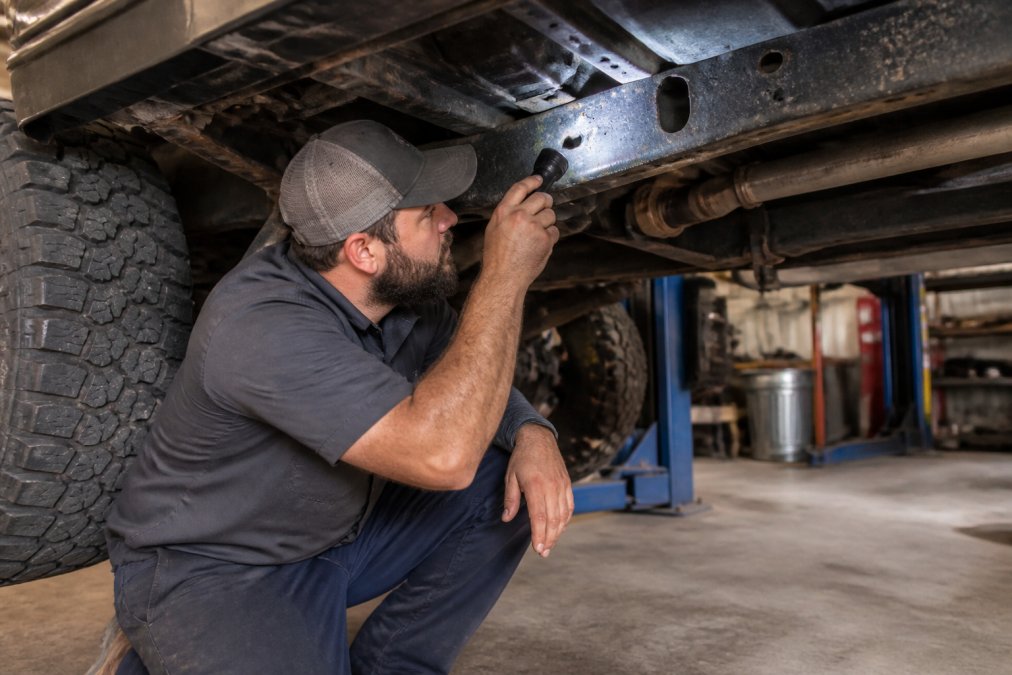
Get under the truck with a bright flashlight and, if possible, a creeper. This is where real frame damage shows itself. On a full-size truck you’re almost always looking at a ladder frame, two parallel steel rails tied together by crossmembers, and knowing that layout tells you exactly where to look.
Know Your Rail Type Before You Look
Truck frames come in two profiles, and each fails differently:
- C-channel (open) rails, shaped like a “C” in cross-section, common on older half-ton and heavier trucks. The open channel traps road salt and moisture, so rust starts on the inside face where you can’t see it. Run your fingers along the inner lip.
- Boxed (closed) rails, fully enclosed steel, common on modern half-tons and heavy-duty trucks. Stronger in torsion, but once water enters through a body-mount hole, it rusts from the inside out. Tap the rail with a small hammer and listen for a dull thud instead of a sharp ring.
The Order to Inspect
Work front to back:
- Frame rails along both sides, from the front bumper mounts to the rear crossmember
- Crossmembers between the rails, especially under the cab and above the rear axle
- Body mounts where the cab and bed bolt to the frame
- Suspension brackets, leaf spring hangers, shock mounts, control arm pivots
- Factory undercoating and seam sealer for gaps, patches, or fresh overspray
What Each Defect Looks Like
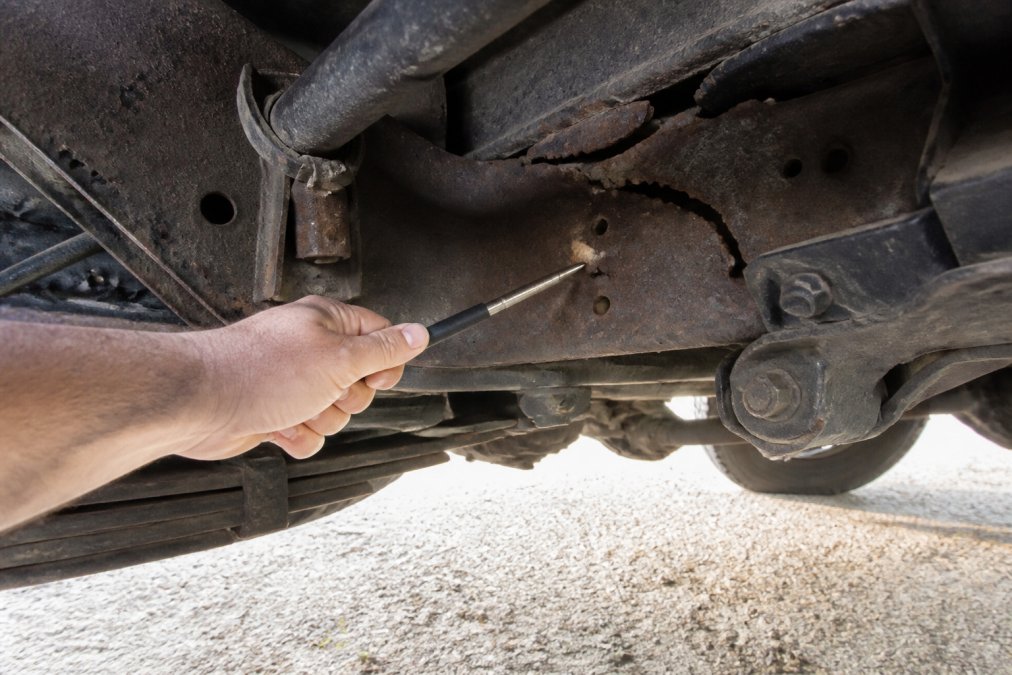
- Rust perforation, flaking scale or holes you can push a screwdriver through. Surface rust is normal; scale that flakes off in sheets is not.
- Cracked welds, hairline cracks radiating from a bracket or mount. Look closely at the weld toe, where the bead meets the base metal.
- Fresh weld marks, bright, uncoated beads, grinding marks, or a weld that doesn’t match the factory pattern. A repaired rail is a red flag even if it’s straight.
- Wrinkles or kinks, metal that buckled under impact and was hammered or pulled back. Look for ripples along the rail’s flat face and a “memory” bend near the impact point.
- Mismatched paint or undercoat, a patch sprayed over one section usually hides a repair.
- Crushed or oval bolt holes, body-mount holes that are no longer round mean the frame shifted under load.
Measuring for Symmetry
A bent frame often hides in plain sight. Catch it with a tape measure and a level.
- Diagonal cross-measure: Pick two matching reference points on opposite rails, for example, the front body-mount hole on the driver side and the rear body-mount hole on the passenger side. Measure diagonally to the opposite corners. Then measure the other diagonal. On a straight frame the two numbers should match within about 1/8 inch. A difference of 1/4 inch or more is a strong sign the frame is diamonded or swayed.
- Ride height: Park on flat ground and measure from the ground to the bottom of each frame rail at the same fore-aft point on both sides. A difference of more than about 1/2 inch suggests a sag or a bent rail.
- String line: Run a taut string along the outside face of each rail from front to rear. The rail should touch the string evenly. Gaps or contact points that change along the length indicate a bend.
A frame machine can pull a bent rail back into spec, but a repaired frame is never as strong as a factory one. If you see signs of a major pull, fresh welds, ground-down rivets, or a rail that measures straight but shows heat discoloration, treat the truck as compromised and price it accordingly.
Truck-Specific Trouble Spots
- Behind the rear cab mounts, where the frame flexes most under load
- Above the rear axle, where heavy payloads and trailer tongue weight concentrate stress
- Front horn area, the forward-most section of the rail, commonly crushed in front-end collisions
- Under the bed floor, crossmembers here rot from the top down where water pools
If you find rust that flakes, a weld that doesn’t belong, or a diagonal measurement off by a quarter inch, stop and get a professional opinion before you make an offer.
How to Verify Used Truck History Before You Buy
A vehicle history report is your first filter, not your final answer. It can flag a salvage title, a totaled record, or an insurance payout tied to structural damage, but it can also miss a lot, and its language is deliberately vague.
- State DMV records (title brand history)
- The National Motor Vehicle Title Information System (NMVTIS), which aggregates state title data
- Insurance claim databases and auction/salvage listings
- The manufacturer’s recall and service records, if available
Decoding Vehicle History Reports for Frame Damage
Reports use vague language. Learn the code words, and the difference between an accident flag and a structural damage flag.
- “Accident reported”, the vehicle was in a collision, but the report does not say the frame was affected. This could be a fender-bender or a major hit. It tells you to look harder, not to walk away.
- “Structural damage”, the frame or unibody was hit hard enough that a repair facility or insurer flagged the structure. This is the flag that matters most on a truck.
- “Salvage title”, an insurer declared the truck a total loss. In most states this means the cost to repair exceeded a set percentage of the vehicle’s value (commonly 70-75%, though the threshold varies by state).
- “Rebuilt” or “Reconstructed”, someone repaired the truck and got it re-titled. A rebuilt title on a truck with a ladder frame is not automatically disqualifying, but it demands a close inspection of the repair quality.
- “Flood”, water damage. Flooded frames rot from the inside, and the rust often doesn’t show for months.
- “Junk” or “Parts Only”, the truck was never meant to return to the road. If you see this, stop.
Reading Between the Lines
A clean report doesn’t mean a clean truck. Plenty of damaged trucks never get reported, especially if the repair was paid out of pocket or done at a shop that doesn’t report to data providers.
Here’s how to read a report critically:
- Check the timeline. An accident flag followed by a title transfer three months later is a different story than one followed by a transfer three years later.
- Look at the mileage progression. A sudden jump or a gap in reported mileage can indicate the truck sat in a repair shop, or that the odometer was tampered with.
- Compare report sources. If one provider shows an accident and another doesn’t, the accident is real, the second provider just didn’t get the data.
- Check the state of title. A truck titled in a state with lax disclosure rules may have damage that a stricter state would have branded.
Cross-Checking the VIN
The VIN ties everything together. Decode it to confirm the truck is what the seller claims, year, make, model, engine, and plant. A VIN that decodes to a different configuration is a serious red flag.
Then run the VIN through:
- NMVTIS (federally mandated, aggregates state title brands)
- At least one commercial provider (Carfax or AutoCheck)
- A free salvage auction search (Copart, IAAI) to see if the truck ever appeared at auction
- The manufacturer’s owner portal for open recalls
Treat the history report as one clue among many, not as proof. A clean report plus a careful undercarriage inspection is far stronger than either one alone. If the report shows structural damage and the seller can’t produce repair documentation, walk away.
When the Report Is Clean but the Truck Isn’t
Some of the worst trucks have the cleanest reports. If the report is clean but your inspection found fresh welds, mismatched paint, or an off diagonal measurement, trust your eyes over the paperwork, the frame itself is the final word.
Used Truck Pre-Purchase Inspection Checklist
A used truck pre-purchase inspection checklist keeps you from missing steps when you’re excited. Print this and bring it.
- Walk-around: check all panel gaps and paint match
- Look for overspray on trim, bolts, and seals
- Check tire wear pattern on all four corners
- Confirm the truck sits level on flat ground
- Test drive: watch for pull, vibration, or dog-tracking
- Get under the truck with a flashlight
- Inspect frame rails for rust, cracks, and bends
- Check crossmembers and body mounts
- Look for fresh welds or undercoat patches
- Pull the VIN and order a history report
- Cross-check the report against state records
- Ask for maintenance and repair receipts
- Get a second opinion if anything looks off
When to Call a Professional for a Frame Inspection
Some frame damage hides where you can’t see it. Laser measurement and a frame machine reveal bends the eye misses. If you’re spending serious money, an independent inspection pays for itself.
Professional inspections matter most when:
- The truck is out of state and you can’t see it in person
- The price is high enough that a hidden problem would hurt
- The history report shows gaps or red flags
- You’re buying for a fleet and need consistent checks
If you’re buying out of state, schedule the inspection before you book travel. A report in hand lets you make an offer with real numbers, not hope. If the truck fails, you’ve saved a flight and a bad purchase.
Conclusion
A used truck with hidden frame damage can drain your wallet and put you at risk on the road. The good news: most problems leave clues, and a careful inspection catches them before you sign anything.
Frequently Asked Questions
How to tell if a truck has frame damage?
Look for body panel gaps that are uneven, tires that wear unevenly, and a truck that pulls to one side while driving. Get underneath and check the frame rails for bends, cracks, or rust perforation. Check for cracked welds and mismatched bolt holes. A vehicle history report can flag past accidents, but only a physical inspection confirms frame damage.
Will Carfax show frame damage?
A Carfax report may show an accident or a salvage title, but it will not always list frame damage specifically. Not every repair shop reports to Carfax, and private repairs often go unreported. Treat the history report as one piece of evidence, not proof. Always follow up with a hands-on inspection of the frame rails and undercarriage.
What are the visual signs of a bent truck frame?
A bent frame often shows as uneven gaps between the cab and bed, a hood or door that does not sit flush, or a truck that sits lower on one side. Underneath, look for wrinkled metal, fresh undercoating hiding repairs, or frame rails that are not parallel. Irregular tire wear and a steering pull are also common indicators.
Can a professional inspection detect frame damage that a history report misses?
Yes. A history report only captures what was reported, and many frame repairs are done privately or never documented. A professional inspector uses laser measurement, checks frame squareness, and examines welds and bolt holes up close. That hands-on approach catches damage that a clean history report can easily miss.