

Table of Contents
- Why a Pre Purchase Inspection Checklist Saves You Thousands in 2026
- The Used Car Inspection Checklist for Buyers: 8 Areas That Matter Most
- Digital Diagnostics and EV Inspection: What Most Checklists Miss
- How Much Does a Pre-Purchase Inspection Cost in 2026?
- What a Pre-Purchase Inspection Report Sample Should Include
- Mobile Pre-Purchase Inspection Services: How They Work
- Using Inspection Findings as Negotiation Use
- Conclusion
- Frequently Asked Questions
Last Updated: September 30, 2026
Why a Pre Purchase Inspection Checklist Saves You Thousands in 2026
A pre purchase inspection is a documented, system-by-system evaluation of a used vehicle before money changes hands. It surfaces what a seller has an incentive to hide: frame damage, flood history, rolled-back odometers, and deferred maintenance.
The Used Car Inspection Checklist for Buyers: 8 Areas That Matter Most
These eight areas form the backbone of any credible used car inspection checklist for buyers; skipping one leaves a blind spot a seller can exploit.
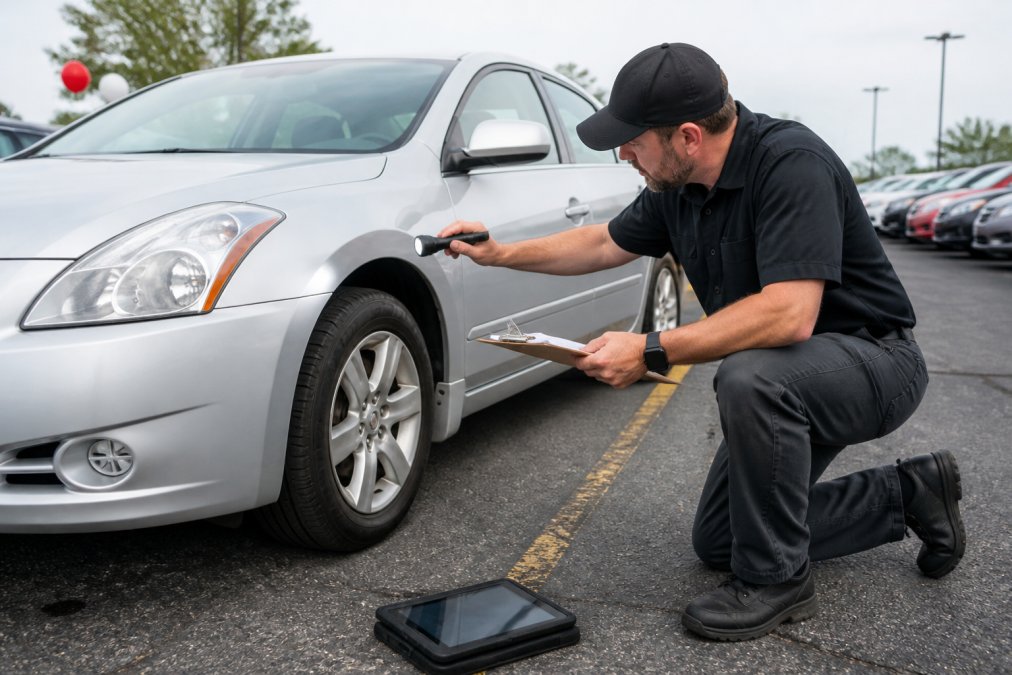
Exterior, Interior, and Under-the-Hood Checks
Start outside and work inward. Check body panels for paint thickness variation, panel gap inconsistency, and rust at wheel arches and rocker panels. Overspray or mismatched paint usually signals accident history.
Tires, Fluids, Warning Lights, and the Test Drive
Tread depth tells you what the owner neglected. Uneven wear indicates alignment or suspension components out of spec. Check all four tires and the spare.
Never accept a seller’s offer to “warm up the car for you” before you arrive. A pre-warmed engine masks cold-start misfires, exhaust smoke, and idle problems, which are exactly the symptoms you are there to catch.
Digital Diagnostics and EV Inspection: What Most Checklists Miss
Most printable checklists stop at visual inspection, leaving the two highest-value modern checks on the table: a scan tool session that reads what the dashboard hides, and an EV-specific evaluation combustion-era checklists don’t cover.
Running an OBD-II Scan During a PPI
Every vehicle sold in the United States since model year 1996 carries a standardized OBD-II port, and since 2008 the connector has been required within three feet of the steering wheel, in practice, under the driver’s side dash. A basic Bluetooth or handheld scan tool that reads generic powertrain codes costs less than a tank of gas; a mid-tier tool that reads manufacturer-specific codes and live data pays for itself on the first car you walk away from.
The procedure, in order:
- Key on, engine off. Read stored codes first. These are confirmed faults the computer has already logged.
- Read pending codes. Pending codes are faults detected on a single drive cycle that haven’t repeated yet. They are the early warnings a seller may not have had time to clear.
- Check monitor readiness. This is the step most buyers skip. Federal emissions rules require the on-board computer to run self-tests (catalysts, oxygen sensors, EVAP, misfire) called readiness monitors, and clearing codes resets them to “not ready.” A car just driven 30 minutes that still shows multiple monitors “not ready” has very likely had its codes wiped recently; a legitimately repaired car shows most monitors “ready” after a normal drive cycle.
- Pull freeze-frame data on any stored code. Freeze-frame captures the engine conditions, RPM, load, coolant temperature, vehicle speed, at the moment the fault set, telling you whether the failure happened at cold start, under load, or at highway speed.
- Watch live data at idle and at 2,500 RPM. Look for fuel trims drifting far from zero, an oxygen sensor that isn’t switching, or a coolant temperature that never reaches normal operating range (a stuck-open thermostat).
A seller who says “the check engine light was on but my mechanic cleared it” has just told you the monitors are reset and the underlying fault may still be present. Scan the car anyway, and treat “not ready” monitors as a yellow flag until a full drive cycle proves otherwise.
EV-Specific Inspection Points
On a battery-electric vehicle, the mechanical checklist shrinks and the battery checklist takes over. The traction battery is the most expensive component, so its condition drives the valuation.
- State of health (SOH). Most EVs expose a battery health or capacity readout in a service or diagnostic menu; some require a scan tool with EV support. SOH is a percentage of original usable capacity, and a car showing meaningfully degraded SOH should have that spent battery life priced in.
- Charging port and cable integrity. Inspect the port for bent pins, scorching, moisture intrusion, or a loose latch. Test both AC (Level 2) and DC fast charging if the seller will allow it. A port that won’t latch or a car that faults mid-session is an expensive repair.
- DC fast-charge behavior. Plug in and watch the charge rate climb. A battery that accepts charge slowly, tapers early, or triggers a fault at a fast charger may have thermal management or cell-balance problems the seller already knows about.
- Thermal management. Ask whether the pack is liquid-cooled or air-cooled and whether the coolant has ever been serviced. Cabin heat and A/C draw heavily on the pack; run both during the test drive and watch for a disproportionate range drop.
- Software and recall status. Check the VIN against the manufacturer’s recall lookup. Battery-related recalls and software updates are common, and an unaddressed one is a negotiating item.
On any EV, request a charging session during the inspection and time how long the car holds its peak charge rate. A pack that holds peak for several minutes is behaving normally; one that immediately tapers is telling you something.
Hybrids Sit In Between
A hybrid needs both checklists. Scan the hybrid control module for codes (a generic scan tool may not reach it), test the battery cooling fan and filter, and listen for unusual inverter whine on the test drive. Ask for the hybrid battery’s age and remaining warranty, many manufacturers cover the pack for 8 years or 100,000 miles, and some states extend that further.
How Much Does a Pre-Purchase Inspection Cost in 2026?
Inspection pricing depends on vehicle type, location, and report depth, so there is no single figure, but the structure is predictable, and knowing it lets you budget before you call.
The Three Tiers You’ll See
Most providers price into three rough bands:
- Basic mobile visual + scan. A walkaround, interior check, under-hood look, OBD-II scan, and a short test drive. This is the entry tier and the most common purchase for a private-party sedan or SUV.
- Comprehensive. Adds an undercarriage inspection on a lift or ramps, brake and suspension measurement, fluid sampling, a longer test drive, and a photo-documented report with pass/caution/fail ratings per system.
- Specialty / heavy-duty. Adds compression or cylinder-contribution testing, commercial vehicle components (air brakes, DOT items, fifth wheel), or EV battery diagnostics. Priced highest because it takes the longest and requires specialized tooling.
Within each tier, price moves with travel distance, vehicle size, and whether the inspector needs a lift: a mobile inspector driving to a rural private seller charges more than one meeting you at a metro dealership.
How to Think About the Cost
The right frame is a fraction of the purchase price, not a standalone expense: a professional inspection is a small percentage of what you’re about to spend and protects the entire amount. Compare it to the first repair bill on a car with hidden damage, a transmission, hybrid battery, or frame repair each dwarf the inspection fee by an order of magnitude.
What Drives the Price Up or Down
- Vehicle type. Compact car < SUV < heavy-duty truck < EV with battery diagnostics.
- Access. A lift-equipped shop vs. a driveway.
- Travel. Distance from the inspector’s base.
- Turnaround. Same-day or rush reports cost more.
- Report depth. A one-page summary vs. a photo-documented, system-by-system report.
What You Should Get for the Money
Regardless of tier, a fair price buys you: a VIN and odometer record, date-stamped photos of every defect, a pass/caution/fail rating per system, scan results including pending codes and monitor readiness, test-drive notes, and a plain statement of what was not inspected. If a provider won’t say what’s excluded, keep shopping.
The inspection fee is the cheapest line item in the entire transaction. The expensive line items are the ones you didn’t know about before you signed.
What a Pre-Purchase Inspection Report Sample Should Include
A pre-purchase inspection report sample is a photo-documented, system-by-system record of condition findings, not a one-line verdict. The format matters as much as the findings: the report is your evidence in a negotiation and your protection if something surfaces later.
A complete report includes:
- Vehicle identification details and odometer reading at time of inspection
- Date-stamped photographs of every defect found, plus overall condition shots
- A pass, caution, or fail rating for each of the eight inspection areas
- Diagnostic scan results, including stored and pending fault codes
- Fluid condition and leak observations
- Test drive notes covering transmission, brakes, steering, and suspension behavior
- A clear statement of what was not inspected and why
Mobile Pre-Purchase Inspection Services: How They Work
Mobile pre-purchase inspection services send an inspector to the vehicle, dealership, private driveway, or auction lot. You never move the car, and you never rely solely on the seller’s photos.
The process is straightforward:
- Book the inspection with the vehicle’s location and VIN
- The inspector travels to the vehicle and performs the full checklist
- You receive a photo-documented report, typically within a day or two
- You review findings before making an offer or finalizing payment
The inspector’s independence is the product. An inspector paid by the buyer has no financial interest in whether the sale closes, which is the only structural guarantee that findings will be reported honestly.
Using Inspection Findings as Negotiation Use
Inspection findings convert from information into money at the negotiating table: a documented defect isn’t an opinion, it’s a repair estimate waiting to be priced.
| Finding Type | Example | Negotiation Move |
|---|---|---|
| Safety-critical | Frame damage, brake failure | Walk away or demand full repair credit |
| Expensive but fixable | Transmission slip, AC failure | Request price reduction equal to repair quote |
| Maintenance deferred | Worn tires, old fluids | Ask for cost of parts, not labor |
Buyers negotiating on a vehicle with multiple mid-tier findings, where a documented repair total can realistically move the price by more than the inspection cost.
Conclusion
The gap between what a seller knows and what you can see is where bad purchases happen, and no amount of photos or video calls closes it. A structured checklist, a diagnostic scan, and an independent set of eyes do.
Frequently Asked Questions
What should be included in a pre-purchase inspection?
A thorough pre-purchase inspection covers exterior body and paint condition, interior cabin and electronics, under-the-hood mechanical components, tire tread depth, fluid levels and leaks, warning lights, brake and suspension health, and a test drive. It should also include an OBD-II scan for stored codes, a VIN check against the vehicle history report, and rust or frame damage assessment. Professional inspections add photo documentation and a written report you can use for negotiation.
How much does a pre-purchase inspection cost in 2026?
Costs vary based on vehicle type, location, and how detailed the inspection is. Basic mobile inspections typically start lower, while comprehensive reports for classic, exotic, or heavy-duty vehicles cost more. Pricing depends on the vehicle, travel distance, and turnaround time, so request a quote for your specific situation. Compared to the cost of hidden frame damage or a rolled-back odometer, the inspection fee is a small price for certainty.
Can I perform a pre-purchase inspection myself or do I need a pro?
You can handle basic visual checks like tire tread depth, fluid levels, and warning lights yourself. However, a professional inspection adds an OBD-II diagnostic scan, chassis and suspension evaluation, paint thickness readings, and flood or frame damage detection that most buyers cannot assess. For high-value vehicles, remote purchases, or anything with a questionable history, a professional pre-purchase inspection is worth the investment.
Does a pre-purchase inspection cover flood damage and odometer fraud?
A quality inspection looks for flood damage signs like waterlines, musty odors, rust in unusual places, and electrical gremlins. Odometer fraud detection relies on comparing the VIN check and vehicle history report against wear patterns on pedals, seats, and steering. Independent inspectors with no financial stake in the sale are best positioned to flag these issues honestly, since they have no incentive to downplay what they find.
What are the most common red flags found during a vehicle inspection?
Common red flags include mismatched paint or overspray suggesting accident repair, uneven tire wear pointing to alignment or suspension problems, coolant or oil leaks, transmission shifting hesitation, dashboard warning lights that were recently cleared, and rust on frame rails. Service records gaps and a VIN check that shows salvage or flood history also raise concerns. Any of these should prompt a closer look or price renegotiation before you buy.
How fast can a mobile pre-purchase inspection service turn around a report?
Turnaround depends on the provider and vehicle location. Some mobile services deliver photo-documented reports within 24 to 48 hours of the on-site inspection. If you are flying out to see a vehicle or need to make an offer by a deadline, confirm the timeline upfront. Ask whether rush scheduling is available and whether the inspector can travel to dealerships, private sellers, or auction lots.