
Table of Contents
- Start With the Vehicle History Report for Flood Damage
- Signs of Flood Damage in a Car: What to Look For First
- The Flood-Damaged Car Checklist: A Step-by-Step Inspection Sequence
- Flood Title vs. Salvage Title: What the Paperwork Tells You
- Mechanical and Safety Consequences of Buying Flood Damaged Cars
- When You Find Warning Signs: Next Steps Before You Buy
- Conclusion: Protect Your Investment From Hidden Flood Damage
- Frequently Asked Questions
Last Updated: October 5, 2026
Start With the Vehicle History Report for Flood Damage
A vehicle history report is the fastest first filter when you want to know how to spot flood damaged cars, but it only works if you read the title brands, not just the summary. Reports pull from insurance claims, state motor vehicle records, and auction data, and a flood event often shows up as a branded title, an insurance total loss, or a registration gap.
Order the report before you drive anywhere. Then look for these entries:
- Flood or water damage brand on the title
- Salvage or rebuilt title from a total-loss claim
- Junk title that was later washed and reissued
One gap means nothing alone; two or three together deserve a closer look.
A clean report is not proof of a clean car. Some flood cars are dried out, cleaned, and resold without ever being reported to an insurer. The paperwork narrows the field. Your eyes and a flashlight do the rest.
Signs of Flood Damage in a Car: What to Look For First
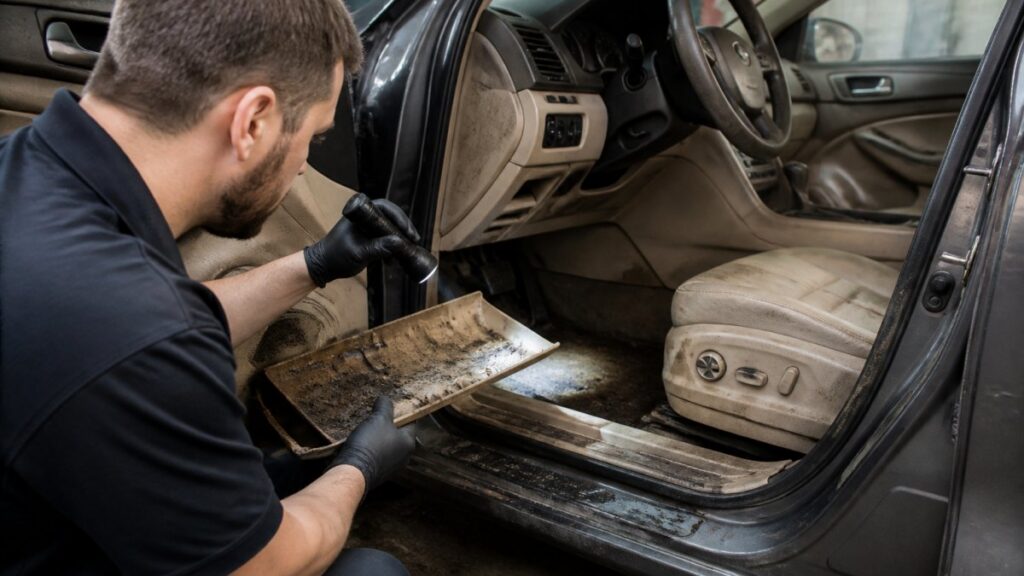
The clearest signs of flood damage in a car are musty odors, water stains, foggy lights, and rust in places that should never rust. Your nose and eyes catch most of them before you ever start the engine. Walk the car slowly and trust your senses.
Bring a flashlight and a rag.
Musty Odors, Damp Smells, and Mold
A musty smell is the single most reliable clue. Mold and mildew grow in carpet padding, seat foam, and the headliner after water sits for even a day.
Open every door, let the car air out, then breathe deep inside. A damp, earthy odor that lingers is a red flag.
Check the trunk and under the seats too. Those areas hold moisture the longest.
Water Stains, Discoloration, and Foggy Lights
Water leaves a line. Look for water stains and discoloration on the headliner, seats, door panels, and carpet; a tide mark tells you how high the water reached.
Foggy headlights and taillights are another tell. Condensation trapped inside a sealed lamp usually means water got in and never drained.
Run your hand along the carpet and floor mats. Crunchy or stiff fabric often means it was soaked and dried.
The Flood-Damaged Car Checklist: A Step-by-Step Inspection Sequence
A flood-damaged car checklist works best in a fixed order, from the outside in, so you do not miss hidden areas. The sequence below covers the exterior, engine bay, interior, and electrical systems.
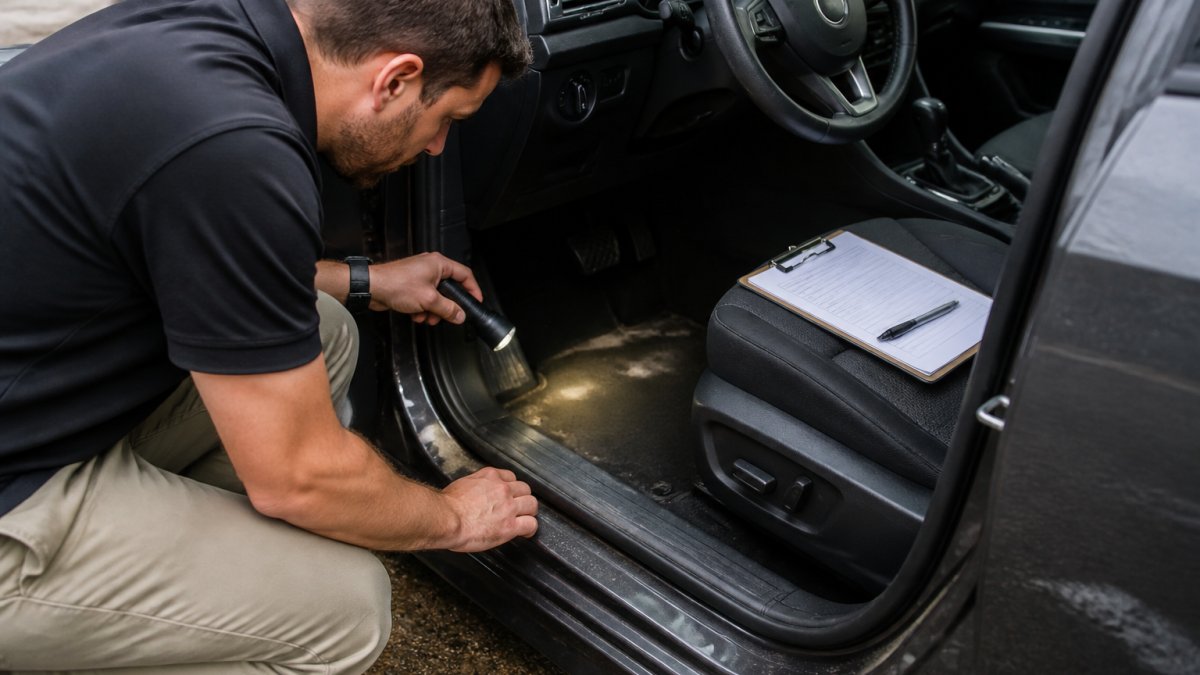
Exterior, Engine Bay, and Hidden Areas
Start outside and work toward the engine.
- Check door seams, trim pieces, and panel gaps for silt or mud.
- Look under the wheel wells and behind the bumpers for trapped debris.
- Open the hood and inspect the engine bay for mud lines on the firewall and hoses.
- Check seat bolts, screws, and brackets for rust and corrosion.
- Look at the water line on the radiator support and inner fenders.
Rust on a bolt head is normal on an older car; rust on a bolt high in the cabin is not.
Interior, Upholstery, and Electrical Systems
Move inside and check the parts water reaches first.
- Seat belts: pull each belt all the way out and check for water stains or stiffness. A gritty retractor is a strong clue.
- Upholstery and carpet: lift the floor mats and press the padding. Damp or crunchy foam points to water intrusion.
- Electrical systems: test every switch, window, light, and screen. Electrical problems are common after flooding.
If several systems act up at once, walk away. Electrical gremlins after a flood are expensive to chase.
Flood Title vs. Salvage Title: What the Paperwork Tells You
A flood title is issued when a vehicle was declared a total loss specifically from water damage, while a salvage title is issued for a total loss from any cause, including collisions. Both mean an insurer paid out and the car was written off; the reason tells you how deep the damage likely went.
| Title Brand | What It Means | Risk Level |
|---|---|---|
| Flood | Total loss from water damage | Highest |
| Salvage | Total loss from any cause | High |
| Rebuilt | Repaired and re-inspected | Varies |
| Clean | No reported total loss | Low, but not zero |
How to Read a Vehicle History Report for Flood Clues
A vehicle history report is not a yes-or-no answer. It is a set of puzzle pieces from sources that do not always talk to each other, insurance claims, state motor vehicle records, auction listings, and service-shop data, and each source has blind spots.
When you read the report, look for these specific entries, not just the summary line:
- Title brand history: a flood, salvage, or junk brand that was later “washed” through a state with looser branding rules.
- Insurance total-loss entries: a payout recorded even if the title itself was never branded.
- Auction listings: vehicles sold through salvage auctions in coastal or hurricane-affected regions.
One entry alone means little. Two or three together, a salvage auction listing, a registration gap, and an out-of-state transfer, deserve a much closer look.
Why a Clean Report Is Not Proof of a Clean Car
Some flood cars are dried out, cleaned, and resold without ever being reported to an insurer. If the owner paid cash for repairs and never filed a claim, no title brand is issued and no insurance entry appears.
A common pattern is a vehicle submerged in a storm, dried in a garage, detailed, and sold privately. The paperwork looks fine because nothing was reported, which is why the report narrows the field but does not clear the car.
How to Verify a Vehicle Across Multiple Records
Do not rely on a single report. Cross-check the same vehicle across more than one source:
- Order a report from a major provider and read the full title history, not just the summary.
- Check the state motor vehicle agency where the car is currently titled and where it was previously titled. Branding rules differ by state, and a brand in one state may not carry over cleanly to another.
- Ask the seller for the physical title and compare the brand on the document to what the report says. A mismatch is a red flag.
- Check the National Insurance Crime Bureau’s VIN check for a free theft and total-loss look-up.
- Search auction archives for the VIN if the report shows a salvage auction entry.
If any source contradicts another, stop and ask why before you go further.
Title washing is the practice of moving a branded vehicle through states with weaker disclosure rules to get a clean-looking title. A car can be branded in one state and titled clean in another. Always check the title history in every state the vehicle has been registered, not just the current one.
Mechanical and Safety Consequences of Buying Flood Damaged Cars
Water damages more than the interior. It attacks the parts you cannot see, and those failures show up months later, often after the warranty, the return window, and the seller’s phone number are gone. Understanding the mechanism tells you which failures are likely and when.
Why Flood Depth and Water Type Change the Risk
Not all floods are equal. The damage profile depends on how deep the water got, what was in it, and how long the vehicle stayed submerged.
- Depth: water below the rocker panels may only reach the carpet and lower wiring. Water above the dashboard reaches the ECU, fuse box, airbag module, and instrument cluster, the expensive electronics.
- Water type: freshwater is corrosive but relatively forgiving. Saltwater is electrically conductive and aggressively corrosive; it attacks connectors, grounds, and bare metal fast. Contaminated water, sewage, chemicals, agricultural runoff, adds health risk and accelerates corrosion.
- Duration: a car that was submerged for an hour may dry out with minimal long-term damage. A car that sat in water for a week has had time for corrosion to start on every exposed surface and for mold to colonize the padding and ducts.
A saltwater flood that reached the dashboard is the worst case; a freshwater splash that reached the floor pans is the mildest. Most real-world flood cars fall in between, and the seller rarely knows or discloses which.
How Water Causes Delayed Failures
Water does not usually kill a component on contact. It starts a process that takes weeks or months to finish.
- Corrosion in connectors and grounds: water seeps into electrical connectors, and the metal pins corrode. The connection still works at first, then becomes intermittent, then fails. This is why electrical gremlins appear months after purchase.
- Contaminated fluids: water enters the transmission, differential, brake system, and power steering through vents and seals. The water breaks down the lubricating properties of the fluid, and the internal parts wear against each other. By the time you notice a shift problem, the damage is done.
- Wheel bearings and brake calipers: water washes out the grease. The bearing runs dry, overheats, and fails, sometimes at highway speed.
A Realistic Timeline of Failures
The failure pattern follows a rough timeline:
- Days to weeks: musty odor returns, warning lights flicker, infotainment and power windows act up.
- One to six months: transmission shifts rough, bearings whine, brake pedal feels soft, corrosion appears on undercarriage fasteners.
- Six to twenty-four months: structural rust advances, airbag system faults surface, electrical faults become chronic and hard to trace.
The real cost is not the purchase price but the repair bill six months later, plus the resale value you lose when the next buyer runs a report.
A flood car can look and drive fine on the lot. The damage shows up in the months after you buy, when the electrical faults and corrosion start to surface. The deeper the water and the longer the exposure, the faster the timeline runs.
When You Find Warning Signs: Next Steps Before You Buy
Finding a warning sign does not always end the deal, but it should stop you from buying on the spot. Here is how to handle it.
- Walk away from the test drive and take photos of what you found.
- Ask the seller directly about flood history and title status.
- Request the full vehicle history report if you have not already.
- Get a professional pre-purchase inspection before you commit.
- Check the title brand with the state motor vehicle agency.
A seller who hesitates on any of these is telling you something.
This is where an independent inspection earns its keep. At Whyte Knyte Inspection, our mobile inspectors travel to the vehicle, dealership, private driveway, or auction lot.
If you are buying from out of state, never rely on video alone. A seller can frame a shot to hide a water line. An inspector on site can lift the carpet and check the seat bolts in person.
Conclusion: Protect Your Investment From Hidden Flood Damage
Hidden flood damage is one of the hardest problems to catch and one of the most expensive to fix. The signs are there if you know where to look: the smell, the stains, the rust, the foggy lights.
When the stakes are high, bring in a professional. Whyte Knyte Inspection offers mobile inspectors, independent reporting with no stake in the sale, and full photo documentation of what we find, all delivered within 24 to 48 hours.
Frequently Asked Questions
How can you tell if a used car has been in a flood?
Look for a combination of clues rather than a single sign. Check for musty odors, water stains on upholstery and the headliner, foggy headlights with visible water lines, rust on seat bolts and door seams, and silt or mud in the engine bay. Electrical problems, like malfunctioning windows or dashboard lights, are also common. A vehicle history report and a title search can confirm what a visual inspection suggests.
What is the difference between a flood title and a salvage title?
A flood title is a specific brand applied when an insurance company declares a vehicle a total loss due to water damage. A salvage title is broader and covers any vehicle deemed a total loss, including from collisions or theft. A flood title always indicates water damage, while a salvage title may not. Both reduce resale value and can affect insurability, so check the title brand carefully before purchase.
Can a vehicle history report show flood damage?
Yes, a vehicle history report can show flood damage if the vehicle was reported to an insurance company and branded. It may list a flood title, salvage title, or auction records noting water damage. However, not all flood-damaged cars are reported, especially those from private sales or states with limited reporting. Use the report as one tool alongside a hands-on inspection and a title check.
Should I buy a car that has flood damage?
In most cases, no. Flood damage can cause long-term electrical failures, mold growth, and safety system malfunctions that are expensive to fix and may not appear immediately. If you are considering a flood-damaged vehicle, factor in a professional inspection, potential repair costs, and a significantly reduced price. For high-value or collector vehicles, a pre-purchase inspection by an independent expert is essential before you commit.
Flood damage hides in the places a quick walkaround never reaches. Before you hand over your money, get an independent set of eyes on the vehicle. Whyte Knyte Inspection sends a mobile inspector to the car, delivers a photo-documented report within 24 to 48 hours, and works with zero financial interest in your purchase. Order an inspection with Whyte Knyte Inspection and protect your investment before you buy.