
Last Updated: November 19, 2026
Quick Summary
When buying a used semi truck privately, verify the paperwork first: the title must match the seller’s legal name and photo ID, with no lienholder or salvage brand, and the VIN on the dash, door jamb, and title must all match. Then check odometer and engine hours, run a history report, do a cold walk-around, and book an independent pre-purchase inspection before you pay.
- Ask for the title, maintenance records, vehicle history report, and odometer and engine hour readings before you travel.
- A VIN mismatch between the dash, door jamb, and title means walk away, full stop.
- Do the walk-around in daylight on flat ground with the truck cold, using a flashlight, rag, magnet, and tread depth gauge.
- Plug in a scanner and pull fault codes, since cleared codes leave readiness monitors incomplete.
- Never send a deposit to a seller you have not met, and get the title in hand at the time of sale.
Table of Contents
- Start With the Paperwork: Why Records Decide the Deal
- How to Verify Used Truck History Before You Travel
- Used Semi-Truck Title and Lien Check: Protecting Your Money
- Used Semi-Truck Mileage Guide: Reading Odometer and Engine Hours
- Your Used Semi-Truck Inspection Checklist for the Walk-Around
- Emissions, Diagnostic Codes, and the Test Drive
- Red Flags, Repair Budgeting, and When to Walk Away
- Book an Independent Pre-Purchase Inspection Before You Pay
- Frequently Asked Questions
Start With the Paperwork: Why Records Decide the Deal
Buying a used semi truck privately is a paperwork exercise before it is a mechanical one. The records tell you whether the truck is worth the trip. Buyers often fall in love with a truck’s paint and skip the file.
A private seller has no dealer license to protect and no lot to return to. You carry the risk alone. So start with documents, not diesel.
Ask for these before you book a flight:
- Title in the seller’s name, front and back
- Maintenance records and service history
- Vehicle history report with the VIN
- Odometer and engine hour readings
- Recent repair invoices and parts receipts
No records is not a dealbreaker. It is a discount. But it changes how hard you inspect.
How to Verify Used Truck History Before You Travel
Here is how to verify used truck history without wasting a trip.
VIN cross-check. The 17-character VIN on the dash, the door jamb, and the title must match.
Odometer and engine hours. A semi can idle for years without moving.
History report. Run the VIN through a paid service and read it line by line.
For a deeper walkthrough, our guide on how to verify used truck history covers the full sequence.
VIN, Odometer, and Engine Hours Cross-Check
Write all three numbers down on paper at the truck. Then compare them to the title and the ECM readout. Small differences happen. Big ones do not.
Used Semi-Truck Title and Lien Check: Protecting Your Money
A clean title and a clear lien are the two things that protect your money. Everything else is repairable. Paperwork problems are not. Private sellers are not regulated like dealers, so you have to verify the transaction yourself.
Run a used semi-truck title and lien check before you send a deposit. A lien that follows the truck becomes your problem. Check these items:
- Title matches the seller’s legal name. Ask for a government-issued photo ID and compare the name to the title. If the seller is not the titled owner, ask for a notarized power of attorney.
- No lienholder listed, or a lien release letter in hand. A lien release should be on the lender’s letterhead and identify the truck by VIN.
- No salvage, rebuilt, or flood brand. Check the title brand and run a vehicle history report.
- Odometer statement signed by the seller. Ask for a signed odometer statement from the seller.
- VIN on the dash, door jamb, and title all match. A mismatch means walk away.
Bill of Sale and Transfer Requirements
A bill of sale should include the seller’s name and address, buyer’s name and address, VIN, make, model, year, odometer reading, purchase price, date, and signatures. Some states require a specific form; check your state motor vehicle agency. For heavy trucks, the title transfer process varies: some states require the seller to sign the title over in person, others allow a separate transfer form. Get the title in hand at the time of sale, not promised later.
Payment Safety and Fraud Prevention
Never pay a private seller in cash without a signed bill of sale and the title in hand. Wire transfers and escrow services exist for a reason.
Watch out: A seller who asks you to wire a deposit to a third party or a different name than the title holder is a fraud risk. Insist on meeting at a bank or using an escrow service.
Before you send a deposit, confirm each of these paperwork items is in order.
| Item to check | What to confirm |
|---|---|
| Title name | Matches seller’s legal name and photo ID |
| Lienholder | None listed, or lien release letter in hand |
| Title brand | No salvage, rebuilt, or flood brand |
| Odometer statement | Signed by the seller |
| VIN | Dash, door jamb, and title all match |
| Bill of sale | Names, addresses, VIN, make, model, year, odometer, price, date, signatures |
| Title in hand | Get it at the time of sale, not promised later |
Used Semi-Truck Mileage Guide: Reading Odometer and Engine Hours
Mileage on a semi is only half the story. Engine hours tell you how hard the truck worked while standing still.
A truck that idled for eight hours a night has wear on the engine, not the odometer. Compare the two readings and ask what the truck did for a living. Long-haul highway miles wear differently than stop-and-go city work.
Watch for these odometer red flags:
- Wear on the pedals and steering wheel that does not match the mileage
- Service records showing higher mileage than the dash
- A cluster that looks newer than the rest of the cab
- Engine hours that do not divide sensibly against miles
Our guide on signs of odometer rollback on trucks breaks down the physical tells in detail.
Your Used Semi-Truck Inspection Checklist for the Walk-Around
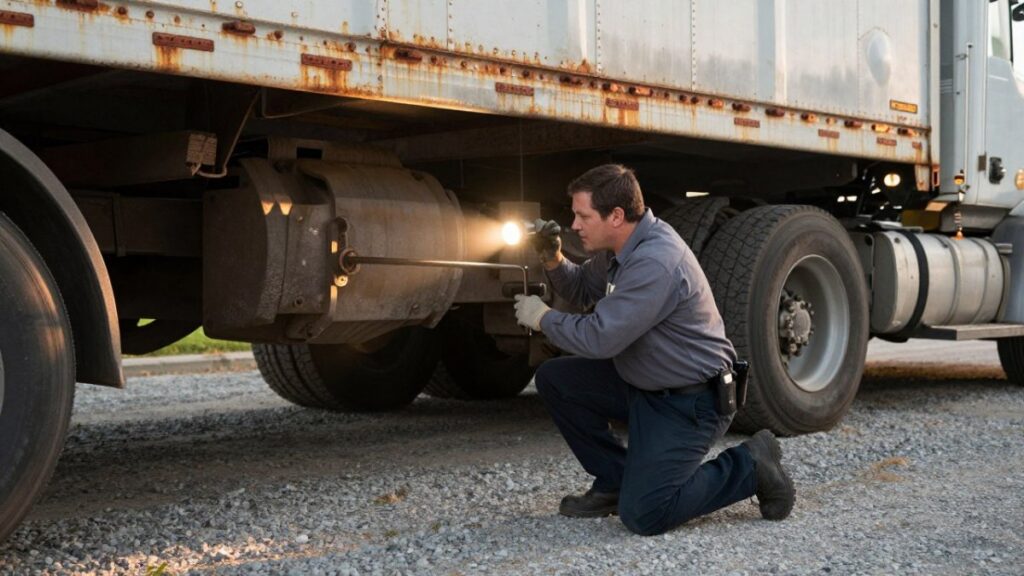
A walk-around inspection is a structured, 30-minute visual and hands-on check of the truck before you start the engine. Do it in daylight, on flat ground, with the truck cold.
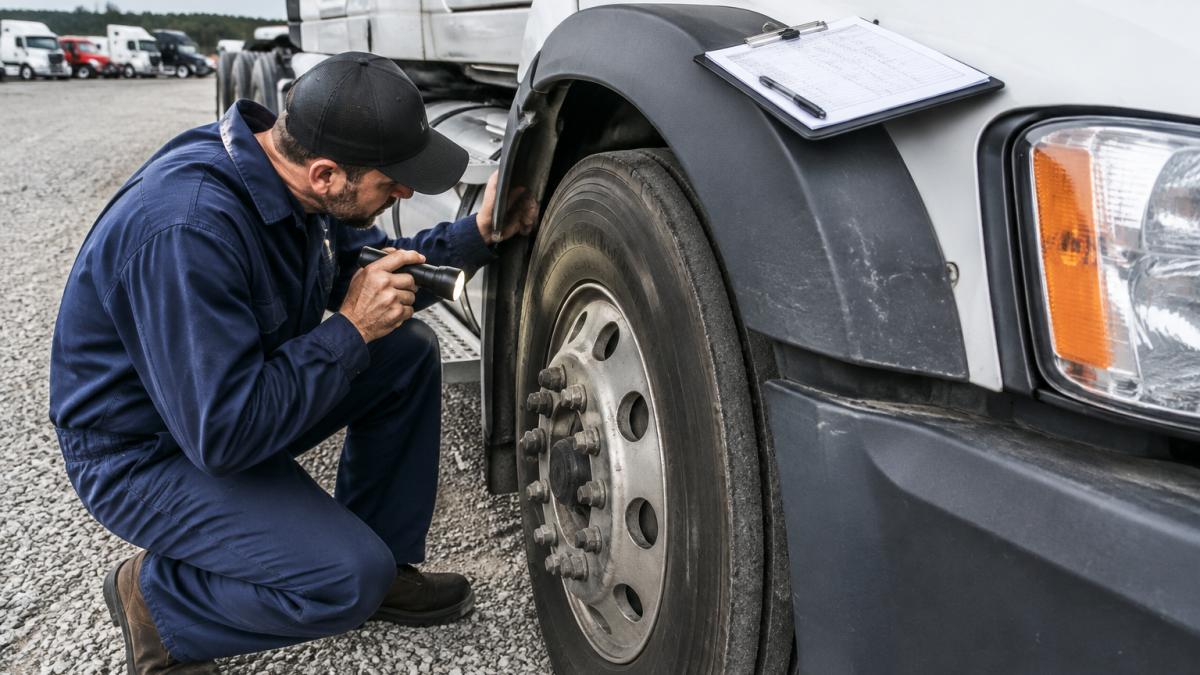
Bring a flashlight, a rag, a magnet, and a tire tread depth gauge. The magnet finds body filler over rust. The rag finds fluid. The gauge gives you a number instead of a guess.
Work in this order and write down what you find:
- Walk the perimeter and check panel gaps and paint match. Mismatched paint on one fender or door often signals collision repair.
- Look under the front bumper for frame and steering damage. Bent bumper brackets and fresh undercoating can hide impact damage.
- Check every tire for tread depth and uneven wear. Measure tread at three points across each tire. Measure the tread carefully; steer tires with shallow tread will need replacement soon.
- Pull the dipstick and smell the oil. Diesel smell is normal; a burnt or fuel-diluted smell is not.
- Open the coolant reservoir and check the color. Milky or oily coolant points to internal problems.
- Look for leaks under the engine, transmission, and rear axle. Fresh cardboard under the truck is a tell.
- Check the fifth wheel for cracks and wear. Look at the locking jaws and the mounting bolts.
- Test every light, mirror, and air line. Air lines should not be cracked or taped.
Engine, Transmission, and Drivetrain Checks
Start the truck cold and listen. A cold start tells you more than a warm one. Knocks, excessive smoke, or a slow crank are warning signs. Check the oil for grit and the coolant for oil sheen. Both point to internal problems. On the transmission, ask when the last clutch service was done. On automated manual transmissions, ask whether the clutch actuator has been serviced.
Leaks, Rust, Frame, Tires, Brakes, and Air Systems
Rust on a semi frame is a structural issue, not a cosmetic one. Look at the frame rails behind the cab and above the rear axle. Flaking metal or deep pitting means walk away. Check the frame for cracks around the fifth wheel mounting and the suspension brackets. Air brakes should hold pressure: with the system charged, shut the engine off and watch the gauge. For a focused guide, read how to detect frame damage on a used truck.
Aftertreatment and Diagnostic Checks
Modern semi trucks carry emissions systems that cost real money to repair. Before you start the engine, look at the aftertreatment system: the diesel particulate filter (DPF), diesel exhaust fluid (DEF) tank, selective catalytic reduction (SCR) unit, and exhaust gas recirculation (EGR) cooler.
Watch out: A seller who has already warmed up the truck before you arrive may be hiding a cold-start problem or a cleared code. Ask to start it cold yourself.
Emissions, Diagnostic Codes, and the Test Drive
Modern semi trucks carry emissions systems that cost real money to repair. A diagnostic scan before the test drive is not optional.
Plug in a scanner and pull the fault codes. Cleared codes leave readiness monitors incomplete. That is a red flag, not a clean bill of health.
On the test drive, check these:
- Shifts cleanly through every gear, up and down
- No vibration at highway speed
- Brakes pull straight and stop hard
- Steering tracks without wander
- Aftertreatment system shows no active warnings
Diesel particulate filter and DEF system repairs are among the most expensive fixes on a modern truck. Get them checked.
Red Flags, Repair Budgeting, and When to Walk Away
Budget for repairs before you make an offer. Every used semi needs something. The question is how much.
Set aside a reserve for the first year. Tires, brakes, and a full fluid service are the usual first costs. A major engine or aftertreatment repair is the worst case.
Walk away when you see:
- A seller who rushes you or refuses an inspection
- Title or VIN mismatches
- Fresh paint over rust or frame damage
- Codes that were cleared before your visit
- A price far below market with a story attached
Fraud in private truck sales is real. Never send money to a seller you have not met, and never skip the paperwork to save time.
Book an Independent Pre-Purchase Inspection Before You Pay
An independent pre-purchase inspection is the last step before money changes hands, and the most important one.
Whyte Knyte Inspection sends mobile inspectors directly to the truck, whether it sits at a private seller’s yard, a dealer lot, or an auction site.
Our service covers all vehicle types, from cars to heavy-duty semi trucks, and is available in 48 states.
If you are ready to arrange an inspection, our pre-purchase inspection checklist guide helps you prepare. Then order an inspection and let a professional advocate look at the truck before you commit.
Frequently Asked Questions
What is a good mileage to buy a used semi truck?
There is no single number that makes a used semi truck a good buy. A truck with 600,000 miles and complete service records can outlast one with 350,000 miles and no history. Look at odometer mileage alongside engine hours, service intervals, and the type of work the truck did. A ratio of roughly 30 to 40 miles per engine hour suggests highway running, while very low miles per hour points to heavy idling or local work. Judge the truck on condition and documentation, not the number alone.
Should I hire an independent inspector for a private semi truck purchase?
Yes, especially when you cannot see the truck in person or the seller is several states away. A qualified mechanic who works on heavy-duty trucks can check the truck in person for condition issues that a video call will not reveal. An independent inspector has no financial interest in the sale, so the report reflects the truck rather than the seller’s asking price. Ask for a photo-documented report you can review before making an offer.
What paperwork should a private seller provide when selling a semi truck?
Ask for the certificate of title in the seller’s name, a bill of sale with the VIN and purchase price, and confirmation that no lien is attached. Request maintenance and service records, and any emissions or aftertreatment repair documentation. Check that the VIN on the title matches the VIN on the truck. If the title is in another person’s name, a lien is listed, or the seller cannot produce records, treat that as a reason to slow down or walk away.
How can you tell if a used semi truck has engine or transmission problems?
Look for leaks around the engine and unusual smoke on start-up. On the test drive, listen for whine or clunk in the transmission, check for slipping under load, and feel for vibration through the driveline. A truck that shifts hard, hunts for gears, or shows repeated aftertreatment faults needs a professional mechanical inspection before you commit.
