Table of Contents
- Step 1: Find the Truck’s VIN and Run a Vehicle History Report
- Interpreting Vehicle History Report Data: Title Brands and Red Flags
- How to Spot Odometer Fraud on Trucks
- Used Truck Pre-Purchase Inspection Checklist: What Reports Miss
- How to Verify Used Truck History When Buying Out of State
- Common Mistakes That Cost Buyers Thousands
- Frequently Asked Questions
Last Updated: September 13, 2026
Step 1: Find the Truck’s VIN and Run a Vehicle History Report
Learning how to verify used truck history starts with one 17-character code: the vehicle identification number. According to NHTSA’s VIN decoding guidance, every VIN encodes the truck’s manufacturer, plant, model year, and serial number, which makes it the key that unlocks every record attached to that vehicle. This guide from Whyte Knyte Inspection walks through the full verification process, from pulling the report to inspecting what the report can’t see.
A vehicle history report is a compiled record of a truck’s title status, accident history, odometer readings, and ownership events drawn from state motor vehicle agencies, insurers, and auction databases. It is a starting point, not a verdict.
Where to Locate the VIN on a Truck
- Driver’s side dashboard, visible through the windshield
- Certification label inside the driver’s door jamb
- Frame stamping or engine block stamping on heavy-duty models
- Title, registration, and insurance documents
Check at least two locations and confirm they match. A mismatched VIN is an immediate walk-away signal.
Free vs. Paid History Report Options
Free tools, including the NHTSA VIN lookup, confirm recalls and basic theft records. Paid reports pull title brands, lien status, and registration history across states. For anything above a few thousand dollars, the paid report is worth it.
Interpreting Vehicle History Report Data: Title Brands and Red Flags
Interpreting vehicle history report data means reading the title section first, because title status outranks everything else on the page. A clean title with consistent registration history is the baseline. Anything else needs scrutiny before you spend money on a pre-purchase inspection.
| Report Signal | What It Means | Buyer Action |
|---|---|---|
| Clean title | No branded damage events | Proceed to inspection |
| Salvage title | Insurer declared total loss | Expect frame or flood damage |
| Flood title | Water damage on record | Walk away |
| Junk vehicle | Not road-legal | Walk away |
| Odometer discrepancy | Rollback suspected | Verify with service records |
| Open lien | Lender still holds interest | Confirm lien release before payment |
Salvage, Flood, and Junk Title Brands Explained
A salvage title means an insurer declared the truck a total loss. Flood damage and junk vehicle brands are worse: flood damage corrodes wiring and frame rails in ways that surface months later, and a junk vehicle brand means the truck was never meant to return to the road.
On trucks, the brand-to-damage link is more predictable than on cars. A salvage brand on a body-on-frame truck usually points to one of three events: a rear-end collision that bent the frame horns, a rollover that twisted the cab, or a flood that submerged the frame rails. Each leaves physical evidence a report cannot show. A rear-end salvage truck often has a replaced bed and a repainted rear frame section; a flood truck shows rust bleeding from body seams and a musty smell in the cab that no amount of detailing hides. When the report shows a salvage brand, your inspection should target the specific damage type the brand implies, not a generic walk-around.
Lien Status, Theft Recovery, and Export Records
An open lien holder can legally repossess a truck you’ve paid for. Theft recovery and export records matter too: a truck recovered after theft may carry hidden structural damage, and export records can indicate a vehicle was built for another market.
Lien status is the one line item buyers most often skip, and it is the one that can cost the entire purchase price. A lien follows the title, not the seller, so a private seller who still owes on the truck cannot legally transfer clean title until the lien is released (State motor vehicle services). Ask for a lien release letter or a title with no lienholder printed on the face. If the seller says the lien was “already paid off,” that is not proof; the state motor vehicle agency record is.
Theft recovery records deserve a second look on trucks specifically. A recovered stolen truck may have had its VIN plates swapped, its frame stamping ground down, or its bed and cab replaced with parts from another vehicle. Cross-check the VIN on the dashboard, the door jamb certification label, and the frame stamping. If any of the three is missing, altered, or does not match, stop the transaction. Export records are a smaller but real signal: a truck originally built for another market may use different emissions equipment, different lighting, or a different frame specification, which complicates parts and service down the road.
A clean title is not the same as a clean truck. Title brands only capture events that were reported to a state agency or an insurer. Frame damage repaired out of pocket, mechanical neglect, and cosmetic cover-ups never generate a brand, which is why the physical inspection in the next section matters as much as the report.
How to Spot Odometer Fraud on Trucks
Odometer rollback is the single most common form of used truck fraud, and it hides in plain sight. Compare the reported mileage across every registration event in the report. If the numbers drop or stall for years, treat it as tampering until proven otherwise.
Trucks make odometer fraud easier to disguise than cars. A diesel engine can run 300,000 miles and still feel tight, so the odometer is often the only clue. Check pedal wear, seat bolsters, and steering wheel shine against the claimed mileage. A truck showing 80,000 miles with a worn-out driver’s seat has a story the seller isn’t telling.
Never accept a “mileage exempt” notation at face value. On older trucks, sellers use it to sidestep disclosure requirements, and it removes your strongest fraud claim if the odometer turns out to be rolled back.
Used Truck Pre-Purchase Inspection Checklist: What Reports Miss
A history report tells you what was recorded. A physical inspection tells you what actually happened. That gap is where buyers lose money, and it’s why a used truck pre-purchase inspection checklist matters more than any single database.
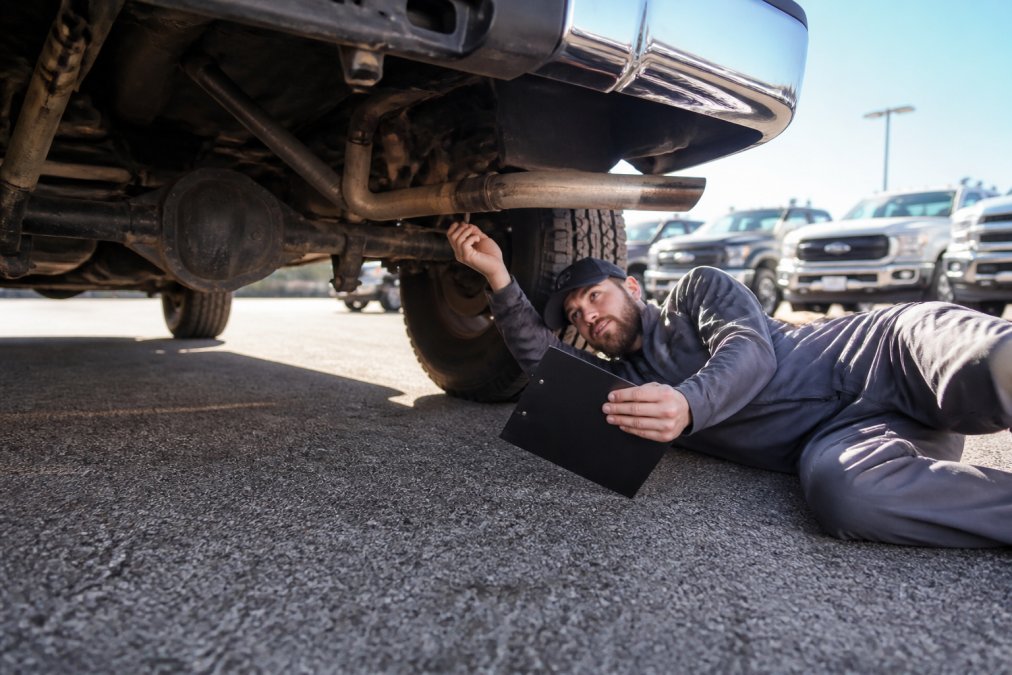
Run through this before you hand over a deposit:
- Frame rails: look for weld marks, bends, or fresh undercoating hiding repairs
- Fluid checks: coolant, oil, and transmission fluid color and level
- Tire wear pattern: uneven wear points to alignment or suspension problems
- Rust: rocker panels, cab corners, and bed mounts on older trucks
- Electrical: test every light, window, and accessory
- Cold start: listen for injector knock or turbo whine
- Test drive: highway speeds, hard braking, and tight turns
Truck-Specific Wear and Tear Indicators
Heavy-duty trucks wear differently than passenger cars. Fifth-wheel and gooseneck mounting plates, air suspension bags, and exhaust brake components take a beating. On diesel models, check for blow-by at the oil filler and inspect the DPF and EGR systems. These repairs run into the thousands, and no history report will flag them.
Commercial vs. Personal Use History
A truck used commercially has likely towed heavy loads and idled for long stretches, which accelerates wear on the transmission and cooling system. Registration history sometimes reveals commercial plates or fleet ownership. If the report shows commercial use, price the inspection accordingly.
Ask the seller directly whether the truck was used for work. Fleet and commercial trucks often have service records that private sellers don’t, and those records are your best evidence of real maintenance history.
How to Verify Used Truck History When Buying Out of State
Out-of-state purchases hide the most risk because title washing moves branded vehicles across state lines until the brand disappears. A truck totaled and rebuilt in one state can appear with a clean title two states over. Understanding the mechanism is what lets you catch it.
How Title Washing Actually Works
Title washing exploits differences in how states brand and re-title vehicles. A truck with a salvage brand in one state gets repaired, then re-titled in a state that does not carry the brand forward or that issues a new title without the prior brand notation. Repeat that across two or three states and the brand can vanish from the paper trail. Trucks are prime candidates because their frame-and-body construction makes rebuilds easier to disguise than unibody cars, and because commercial fleet vehicles often change hands across state lines through auctions.
The practical defense is to pull a history report that aggregates records from all states, not just the state where the truck is currently titled. A single-state report is the tool title washers rely on. Look for gaps in the registration timeline, a title issued in a different state shortly after a salvage event, or a sequence of short ownership periods in different states. Any of those patterns justifies walking away or demanding a full multi-state report before you travel.
A Step-by-Step Out-of-State Verification Sequence
- Request a photo of the physical title, front and back, before you discuss price. Confirm the VIN on the title matches the truck and the report.
- Pull a multi-state history report the week you plan to buy, not weeks earlier. Records update constantly, and a report pulled a month ago may miss a recent brand or lien.
- Ask the seller for the state where the truck was last titled and the state before that. A vague answer is a signal.
- Verify the lien status directly with the state motor vehicle agency that issued the current title, not through the seller.
- Arrange an independent inspection before you travel. A mobile inspector can meet the truck at the seller’s location, whether that is a dealership lot, a private driveway, or an auction yard.
- Never wire funds or pay a deposit before the inspection report is in your hands and the VIN matches across title, truck, and report.
Commercial Use History: The Out-of-State Wildcard
A truck that spent its life in a commercial fleet in another state carries wear that a private-use truck of the same mileage does not. Fleet trucks idle for long stretches between jobs, tow heavy loads regularly, and often accumulate service records that private sellers never keep. Registration history sometimes reveals commercial plates or a fleet-owned title, but not always, especially after a title wash.
Ask the seller directly whether the truck was used for work, and ask for the name on the previous title. If it was a company, treat the truck as commercial until proven otherwise and price the inspection accordingly. Commercial use accelerates wear on the transmission, cooling system, and brakes, and those repairs run into the thousands. A pre-purchase inspection that includes a cold start, a highway test drive, and a frame check is the only way to confirm what the paper trail implies.
When buying out of state, budget for the inspection as part of the purchase, not as an optional add-on. The cost of a mobile inspection is a fraction of the cost of discovering a washed title or a worn-out commercial drivetrain after the money has changed hands.
Common Mistakes That Cost Buyers Thousands
The most expensive mistake is trusting a clean report as a clean truck. Reports miss frame damage, mechanical neglect, and cosmetic cover-ups because those events never generated an insurance claim.
Other costly errors:
- Skipping the lien check, then discovering the lender still holds title
- Buying at night or in rain, when rust and bodywork flaws disappear
- Accepting a seller’s own mechanic instead of an independent inspector
- Paying a deposit before the VIN matches across title, truck, and report
- Ignoring a salvage or flood brand because the price “seems too good”
A history report and a physical inspection answer two different questions. The report tells you what was recorded; the inspection tells you what’s true. You need both before you buy.
Verifying a used truck’s history is a two-part job: pull the digital records, then confirm them with eyes on the frame, the fluids, and the odometer. Reports catch title brands and rollbacks; they can’t catch a cracked frame rail or a failing turbo. Whyte Knyte Inspection closes that gap with mobile inspectors who travel to the truck, document everything in photos, and deliver a report within 24 to 48 hours, backed by over 20 years of automotive experience and zero stake in your purchase. Get started with Whyte Knyte Inspection and make your next truck purchase with confidence.
Frequently Asked Questions
What is the most reliable way to check a used truck’s history?
The most reliable approach combines two methods: pulling a vehicle history report using the truck’s 17-digit VIN, and hiring an independent pre-purchase inspector to physically examine the vehicle. Reports catch title brands, odometer rollbacks, and accident records, but they can miss unreported frame damage or mechanical wear. A physical inspection fills those gaps. Together, they give you a complete picture before you commit to a purchase.
Can I get a free vehicle history report for a truck?
Several services offer limited free VIN checks that show basic title status and recall information. Full reports with accident history, service records, and lien status typically require payment. Free reports can be a useful starting point, but they rarely include everything you need to make a confident buying decision. Budget for a paid report and a professional inspection on any truck you are serious about purchasing.
Does a vehicle history report show all accident damage?
No. History reports only capture incidents that were reported to insurance companies, police, or state agencies. If a previous owner paid out of pocket for repairs or the damage occurred in a state with limited reporting requirements, it may not appear. Frame damage from an unreported collision is one of the most common issues that only a physical inspection can reveal. Treat the report as a starting point, not a guarantee.
Why is a professional pre-purchase inspection necessary if I already have a history report?
A history report tells you what has been documented. An inspection tells you what is actually happening with the truck right now. Inspectors check for frame damage, rust, fluid leaks, tire wear, brake condition, and odometer tampering that reports cannot detect. For trucks used in commercial fleets or heavy towing, mechanical stress often goes unreported. An independent inspection protects your investment by verifying real condition, not just paperwork.