
Last Updated: November 17, 2026
Quick Summary
To verify a used car maintenance history before inspection, request every service record in writing, then authenticate each one against the VIN, dates, and mileage progression. Run the VIN through free NHTSA and state tools, compare the paper trail to the seller’s story, and only then decide whether the file justifies a paid inspection.
- Work through the five verification steps in order before paying for any report or inspection.
- A legitimate invoice lists the VIN or enough vehicle detail to tie it to the car.
- Mileage on each invoice should increase at a believable pace across dates.
- Call the shop on an invoice and ask them to confirm the work on that VIN.
- Treat a major service interval with no record as unperformed until the seller proves otherwise.
Table of Contents
- Why Maintenance History Decides the Inspection Outcome
- How to Verify a Used Car Maintenance History Before Inspection Free
- Pulling Vehicle Maintenance History by VIN
- How to Check Vehicle Service History Free
- Reading a Car Service History Report Without Getting Fooled
- Interpreting Gaps in Maintenance History by Age, Mileage, and Powertrain
- When Records Are Missing: What to Do Before You Book the Inspection
- Booking Your Independent Pre-Purchase Inspection
- Frequently Asked Questions
Why Maintenance History Decides the Inspection Outcome
A pre-purchase inspection tells you what a vehicle looks like today. The maintenance history tells you how it got there.
A car can pass a visual inspection and still hide years of neglect.
Some buyers do this backwards and book the inspection before reviewing the paperwork.
Below, we walk through the full verification process, step by step, so you know exactly what to ask for and how to read what you get.
How to Verify a Used Car Maintenance History Before Inspection Free
Verification starts with paperwork, not a paid report. You can confirm a great deal about a used car’s past without spending a dollar, and you should exhaust those free steps before you pay for anything.
Here is the chronological workflow we recommend to every buyer:
- Request every document the seller has, in writing
- Authenticate each record against the VIN, dates, and mileage
- Run the VIN through free government and history tools
- Compare the paper trail against the seller’s story
- Decide whether the file is strong enough to justify a paid inspection
Step 1: Collect Every Document the Seller Has
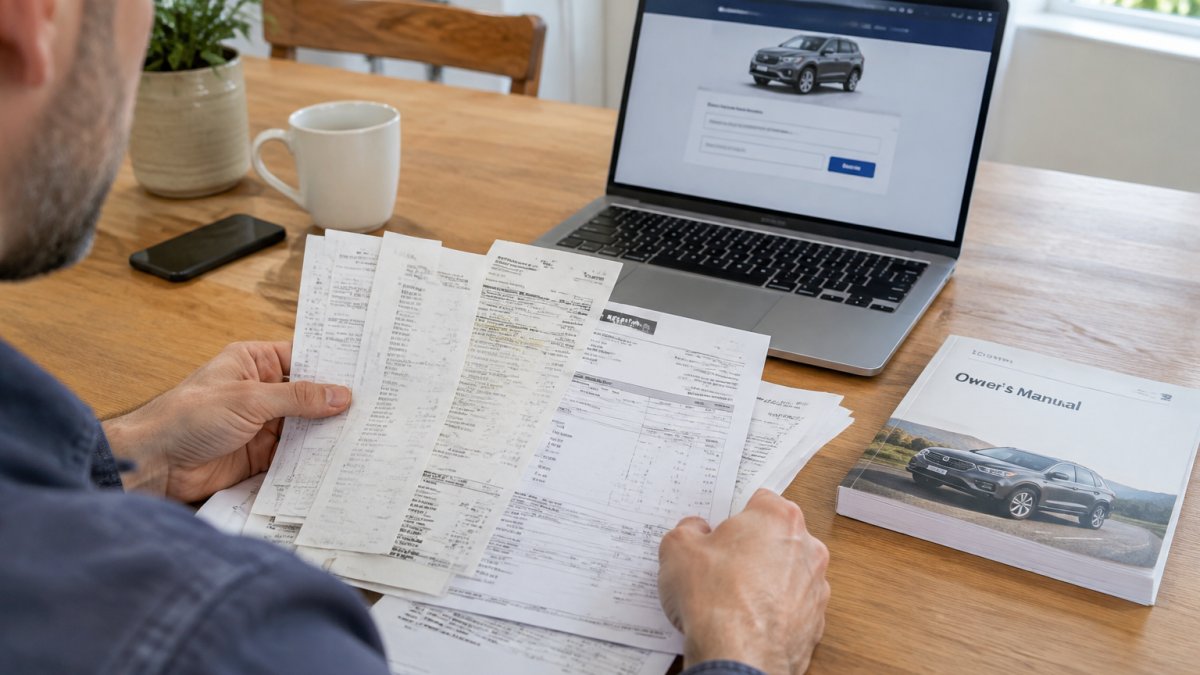
Ask for the full paper trail, not a summary. A serious seller keeps records, and a vague answer here tells you plenty.
- Service and repair invoices from shops and dealers
- Maintenance receipts for oil changes, tires, and batteries
- The owner’s manual, often stamped by a dealer service department
Put the request in writing. An email or text trail protects you if the seller later claims they “gave you everything.”
Watch out: a seller who promises to “find the records later” usually never does. Treat missing documents as missing information, not a minor inconvenience.
Step 2: Authenticate Each Record Before You Trust It
A stack of receipts proves nothing until you cross-check it. Authentication means confirming that each document is internally consistent and tied to the same vehicle. Work through these checks on every invoice:
- VIN match. A legitimate invoice lists the VIN or at least the year, make, model, and license plate. If the VIN is absent, compare the vehicle description to the car you are buying. A receipt for a different trim or engine is a red flag.
- Date and mileage progression. Lay the documents out in date order. The mileage on each invoice should increase at a believable pace. A receipt showing lower mileage than an earlier one points to a rolled-back odometer or a clerical error, both need an explanation.
- Shop identity. A real invoice carries a shop name, address, and phone number. Call the shop and ask them to confirm the work was performed on that VIN. Ask the service department to verify a repair if you provide the VIN and date.
A common pattern is a seller who produces a folder of oil-change receipts but cannot explain a two-year gap in mileage. Authenticate the whole file, not just the parts that look good.
Step 3: Run the VIN Through Free Tools
Once you have the VIN, use free government tools to confirm the car’s identity and safety status. The National Highway Traffic Safety Administration’s VIN decoder confirms make, model, and year. The NHTSA recall lookup tool shows open safety recalls. Your state motor vehicle agency can confirm title and lien status, often for a small fee or free through an online portal.
Step 4: Compare the Paper Trail to the Seller’s Story
Ask the seller open questions before you reveal what you found: How long have you owned it? Where was it serviced? Has it ever been in an accident? Then compare their answers to the documents. Inconsistencies are not automatically disqualifying, but they tell you how much weight to put on the rest of the file.
Step 5: Decide Whether to Proceed
If the records are complete, consistent, and match the seller’s account, you have a strong basis to book an inspection. If the file is thin or contradictory, move to the missing-records playbook below before you spend money on a lift fee.
Work through these five steps in order before you pay for any report or inspection.
| Step | What to do |
|---|---|
| 1 | Request every document the seller has, in writing |
| 2 | Authenticate each record against the VIN, dates, and mileage |
| 3 | Run the VIN through free government and history tools |
| 4 | Compare the paper trail against the seller’s story |
| 5 | Decide whether the file justifies a paid inspection |
Pulling Vehicle Maintenance History by VIN
The vehicle identification number is the backbone of every records check. That 17-character code ties the car to its build data, recall history, and reported service events.
You will find the VIN in several places:
- The lower corner of the windshield on the driver’s side
- The driver’s door jamb sticker
- The engine bay or firewall stamp
Once you have it, run the VIN through the National Highway Traffic Safety Administration’s VIN decoder to confirm the car’s make, model, and year match what the seller claims.
From there, check the NHTSA recall lookup tool for open safety recalls.
How to Check Vehicle Service History Free
Free checks will not give you a full dealer service log, but they cover more than most buyers realize. A free vehicle history report typically shows title events, reported accidents, and sometimes service entries.
Start with these free sources:
- The NHTSA VIN and recall tools
- Your state’s motor vehicle agency for title and lien status
- Free VIN lookups from major history report providers
A car service history report from a paid provider adds depth, including auction records and out-of-state events. We suggest running one free check first to confirm the basics, then deciding whether a paid report earns its cost.
Reading a Car Service History Report Without Getting Fooled
A history report is evidence, not a verdict. Reports pull from many databases, and gaps are normal. The skill is knowing which entries matter.
Focus on these signals:
- Title brands. A salvage title, rebuilt title, or flood brand changes the car’s value and insurance cost.
- Lien status. An open lien means the lender still has a claim on the car.
- Accident and damage records. Minor cosmetic repairs are common. Structural damage is not.
Once you understand the service records, the next document you will face is the inspection report itself. Our guide on how to interpret a used vehicle inspection report walks through each section so nothing gets past you.
Interpreting Gaps in Maintenance History by Age, Mileage, and Powertrain
An empty stretch in the records is not proof of neglect. It is a question you need answered before you commit. The skill is distinguishing ordinary missing documentation from a pattern that predicts expensive repairs.
Read gaps against three factors:
- Age. A ten-year-old car with a five-year gap deserves more scrutiny than a two-year-old lease return. Older cars change hands more often, and independent shops do not always report to history databases.
- Mileage. A gap that spans 40,000 miles is far more serious than one spanning 4,000. Multiply the gap by the manufacturer’s oil-change interval to estimate how many services may have been skipped.
- Powertrain. Turbocharged engines, certain automatic transmissions, and hybrid systems are less forgiving of missed fluid changes. A naturally aspirated engine tolerates more.
Match the Gap to the Manufacturer’s Maintenance Schedule
Pull the maintenance schedule from the owner’s manual or the manufacturer’s website. Identify the major services that fall inside the gap: timing belt, transmission fluid, coolant flush, spark plugs, brake fluid. If a major interval passed with no record, treat it as unperformed until the seller proves otherwise.
Powertrain-Specific Checks
- Turbocharged engines. Missed oil changes are harder on turbo bearings. Look for records of synthetic oil at the manufacturer’s interval and ask whether the turbo was ever inspected.
- Hybrids and electric vehicles. Battery cooling and inverter coolant services are often overlooked. A gap in hybrid service records is a reason to have the high-voltage battery checked during inspection.
- CVT and dual-clutch transmissions. These units are sensitive to fluid condition. A missing transmission fluid service at the recommended interval is a negotiation point, not automatically a walk-away.
A Decision Framework: Continue, Negotiate, or Walk Away
Use the records to sort the car into one of three buckets before you book an inspection:
- Continue. Records are complete or gaps are explained and minor. Book the inspection.
- Negotiate. Records are thin but the car is otherwise strong. Price the risk of the missing major service into your offer, and make the inspection contingent on confirming the work.
- Walk away. Records show a rolled-back odometer, a title brand, an open lien, or a pattern of skipped major services on a high-strung powertrain. Do not spend money on an inspection for a car you already know you should not buy.
A common mistake is treating a single missing oil change as a dealbreaker while ignoring a three-year hole in the middle of the log. Look at the pattern, not one line.
When Records Are Missing: What to Do Before You Book the Inspection
Missing records do not end the deal. They change your approach. When the paper trail is thin, you shift the burden of proof onto the inspection and onto the price.
Here is what to do:
- Ask the seller to request a service printout from their dealer
- Call the shops listed on any partial receipts and confirm the work
- Contact a previous owner if the title shows one
If the records are missing, you will want use before you commit to an inspection. Our guide on how to negotiate price with a private seller covers the specific language to use.
Booking Your Independent Pre-Purchase Inspection
An independent inspection is the final check on everything the records could not prove.
Book with an inspector who has no stake in the sale.
At Whyte Knyte Inspection, our mobile inspectors travel to the vehicle, whether it sits at a dealership, a private seller’s location, or an auction lot.
If the car is out of state, our guide on a pre-purchase inspection for an out of state car covers the logistics. If your timeline is tight, review our fast turnaround vehicle inspection services so the inspection fits your schedule.
The records tell you what the seller wants you to know. The inspection tells you what the car actually is. Get both before you sign.
Frequently Asked Questions
Can I look up a car’s maintenance history by VIN?
Yes. The 17-character VIN is the key that ties a vehicle to its records. A vehicle maintenance history by VIN search through a paid history report service can surface dealer service visits, title events, and reported accidents. Free VIN decoders confirm make, model, and engine but rarely include service entries. Treat any VIN report as a starting point, then confirm each entry against paper receipts or a call to the repair shop that performed the work.
Will a vehicle history report show all maintenance?
No. History reports only capture what was reported to them. Work done at independent shops, at-home oil changes, and cash repairs often never appear. A clean report with no service entries does not prove neglect, and a report full of entries does not prove the car was cared for. Use the report to spot red flags like odometer jumps or salvage title brands, then verify the actual maintenance documentation with the seller before booking a pre-purchase inspection.
What should I do if the seller has no maintenance records?
Ask for the shop name and phone number anyway, then call and request service dates and mileage. Check the oil life monitor, tire date codes, and the condition of the brake fluid and coolant as physical evidence of recent work. A pre-purchase inspection becomes more important, not less, when records are missing, because the inspector has to judge condition without a paper trail. Budget for immediate fluid changes and a full belt and hose review.
How do I check a vehicle’s service history for free?
Start with the free options: request every receipt and invoice from the seller, call the dealership service department with the VIN, and contact independent shops named on any sticker or invoice. Some manufacturers offer free owner accounts that list dealer-performed service by VIN. Free VIN decoders confirm basic specs. Combine these free checks with a paid history report only if the free trail leaves gaps you cannot explain.
