Last Updated: November 14, 2026
Quick Summary
To negotiate price with a private seller, build a file of comparable listings and set a written walk-away price before you talk. Then offer fair market value minus documented repair costs and a risk cushion, and keep texts short and factual while moving serious numbers to a call or in person.
- Pull five to eight comparable listings with the same make, model, close mileage, and similar trim.
- Calculate your offer as comparable market value minus repair costs minus a risk cushion.
- Keep every text message to two or three sentences and never bid against yourself.
- Move to a call when the seller counters, disputes condition, or you need to schedule an inspection.
- Match the VIN on the dashboard, door jamb, and title before any money moves.
Table of Contents
- Start With Research, Not a Number
- How Much to Offer for a Used Car From a Private Seller
- Use a Private Seller Used Car Inspection Checklist Before You Make an Offer
- How to Negotiate Car Price Over Text Without Losing Use
- A Used Car Price Negotiation Script for Every Stage
- Adjust Your Approach to the Seller and the Vehicle
- Close the Deal and Protect the Transaction
- Book an Independent Inspection Before You Settle on a Price
- Frequently Asked Questions
Start With Research, Not a Number
Most buyers open with a number and hope for the best. That is the wrong order.
Here is the core idea: a private-party sale has no invoice, no dealer markup, and no manager to approve a discount.
That framing comes from the FTC and CFPB auto buyer study, which found that invoice prices and competing quotes help buyers negotiate.
Build Your Comparable Listings File
A comparable listings file is a simple record of similar vehicles for sale right now. Pull five to eight listings with the same make and model, close mileage, and similar trim. Save the asking price, mileage, condition notes, and location for each one.
The lowest-priced comparables become your anchor. The highest show the seller what the market will not pay.
Set Your Walk-Away Price Before You Talk
Your walk-away price is the maximum you will pay, decided before any conversation starts. Write it down. Once you are standing in a driveway, emotion takes over.
- Start with fair market value from your comparables.
- Subtract estimated repair costs from the inspection.
- Subtract a margin for unknown risk.
- Round down to a clean figure.
That final number is your ceiling. Anything above it, you walk. This habit protects more money than any clever line you will ever say.
How Much to Offer for a Used Car From a Private Seller
The short answer: offer the fair market value of the car in its actual condition, minus documented repair costs, minus a small cushion for risk.
How much to offer for a used car from a private seller is arithmetic, not guesswork. Take the average asking price of your comparables, adjust for mileage and condition, then subtract what the car needs.
Calculate an Evidence-Based Offer
Use this formula. It works for any vehicle, from a compact sedan to a heavy-duty truck.
Offer = Comparable Market Value – Repair Costs – Risk Cushion
Here is a worked example:
| Line Item | Amount |
|---|---|
| Average comparable asking price | $14,500 |
| Mileage adjustment above average | -$800 |
| Inspection repair estimate | -$1,200 |
| Risk cushion for unknowns | -$500 |
| Your target offer | $12,000 |
Now you have a number with a story behind it. When the seller asks why, you can point to each line.
Watch out: do not skip the inspection before you calculate repair costs.
Use a Private Seller Used Car Inspection Checklist Before You Make an Offer
A private seller used car inspection checklist is a written list of the mechanical and cosmetic items you check before naming a price.
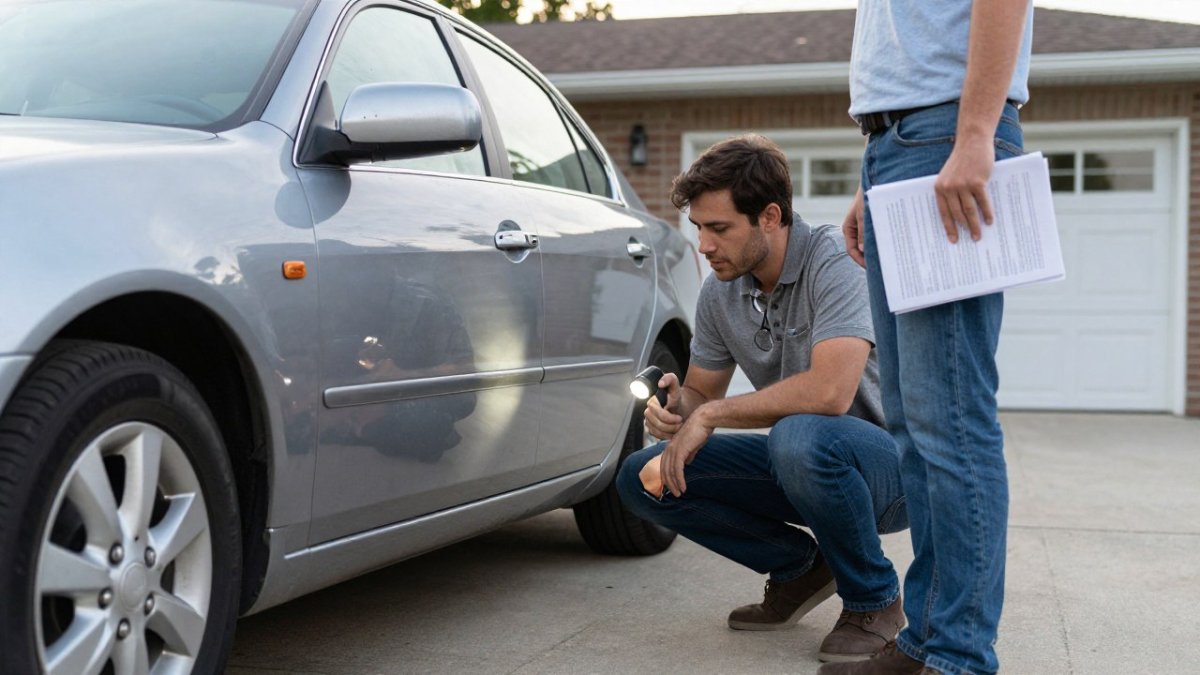
Run through these items in person or through photos and video:
- Tire tread depth and uneven wear
- Body panel gaps and repaint signs
- Frame and underbody rust
Every defect you document becomes a negotiation point. Our own inspectors use this same checklist logic on every vehicle, which is why a remote car inspection matters when you cannot see the car yourself.
For a full walkthrough of what each item means, see our guide to reading an inspection report during negotiation.
How to Negotiate Car Price Over Text Without Losing Use
Learning how to negotiate car price over text comes down to one rule: keep it short, factual, and slow. Text removes tone, so every message should be clean and specific.
Text is useful for setting up the deal, confirming details, and floating a number. It is a poor place for a full negotiation. Move to a call or an in-person meeting once the price gets serious.
Text Negotiation Rules That Protect Your Position
- Open with a question, not an offer
- Ask about service history and reason for selling
- Confirm the title is clean and in the seller’s name
A common mistake is sending three messages in a row when the seller goes quiet. Silence is a tactic. Let it work for you. If the seller pushes for urgency, that tells you something useful about their motivation.
Sample Text Messages for Each Stage
These are templates, not scripts to copy word for word. Adjust the numbers to your own evidence file.
First contact (before any number): “Hi, I’m interested in the [year make model]. Is it still available?
After viewing, floating a number: “Thanks for showing me the car.
Responding to a counter: “I appreciate you coming down.
Declining politely without burning the bridge: “I understand, that’s more than I can justify for this car in its current condition.
Watch out: never send a deposit by peer-to-peer app or wire transfer based on a text conversation alone. Scammers routinely pose as sellers with a car they do not own (Put the brakes on phony online car sales).
When to Stop Texting and Pick Up the Phone
Move to a call when the seller sends a counteroffer, when the conversation turns to condition disputes, or when you need to schedule an inspection. If a seller refuses to talk by phone and insists on text-only plus a deposit, treat that as a warning sign.
A Used Car Price Negotiation Script for Every Stage
A used car price negotiation script is a set of prepared lines you use at each stage of the deal.
Here are the stages and sample lines:
Opening: “Thanks for meeting me. I’ve looked at a few similar cars and done my homework. Based on the condition and what comparable listings are asking, I can offer $12,000 today.”
After the counter: “I hear you. My number came from the repair estimate and the comparables I found. Can we meet closer to $12,500?”
Final offer: “This is my best number. If it works, I’m ready to move forward today.”
Handling the Three Objections You Will Hear
“Someone else is coming to look at it.” Respond calmly: “I understand. My offer stands if it’s still available.” Urgency is often a test.
“I’ve seen these sell for more.” Ask for proof: “Can you share the listing? I’d like to compare it.” Most sellers cannot produce one.
“I’m not dropping below my price.” Respect it and pivot: “I understand.
Adjust Your Approach to the Seller and the Vehicle
Not every negotiation follows the same path. A motivated seller moving out of state is different from a collector who has owned the car for twenty years. Read the situation before you push.
- High demand, low supply: expect to pay closer to asking price
- Rough condition: lean hard on documented repair costs
- Seller urgency: a fast, clean cash offer carries weight
Our buying tips library covers how to read different seller types and vehicle classes before you make contact.
Close the Deal and Protect the Transaction
Closing a private-party sale safely means handling the paperwork, payment, and title transfer in the right order. A handshake is not a deal. A signed title and cleared payment are. This is where buyers lose the most money after they think they have won the negotiation.
Verify the Title, Lien, and Seller Before You Pay
- Match the VIN three ways. Check the VIN on the dashboard, the driver’s door jamb sticker, and the title. They must all match. A mismatch is a reason to walk.
- Confirm the seller is the titled owner. The name on the title must match the seller’s driver’s license. If the seller is flipping a car titled in someone else’s name, you are buying a problem.
- Check for liens. A title with a lien listed means a lender has a claim on the car. Ask for a lien release or a clear title before paying. Some states issue electronic titles, so ask the seller to show a lien release or a title printout from the state motor vehicle agency.
- Look for branded titles. Salvage, rebuilt, flood, and lemon titles are disclosed on the title itself in most states. A branded title cuts resale value sharply and can affect insurance and financing.
- Run a VIN history report. A vehicle history report can surface prior salvage events, odometer rollback, and out-of-state title changes the seller may not mention.
Watch out: a seller who asks for a deposit before you have seen the title and matched the VIN is the single most common private-sale scam pattern. Do not send money to hold a car you have not verified in person.
Meet and Pay Safely
- Meet at a police station, bank, or motor vehicle agency lot during daylight. Avoid meeting at the seller’s home if you are carrying cash.
- Bring a second person and tell someone where you are going.
- Do the title signing and bill of sale at a bank or credit union so payment and paperwork happen together.
What the Bill of Sale Should Contain
A simple bill of sale protects both sides. Include the date, full names and addresses of buyer and seller, the vehicle’s year, make, model, VIN, and odometer reading, the sale price, and a statement that the seller transfers the title free of liens. Both parties sign and keep a copy. Some states require a specific form, so check your state motor vehicle agency’s requirements before the meeting.
Transfer the Title and Register the Vehicle
Title transfer rules vary by state. In general, the seller signs the title over to you, you complete the buyer section, and you submit the title and registration paperwork to your state motor vehicle agency within its deadline. If you are buying across state lines, our out-of-state buying guide walks through the extra steps, including temporary tags and inspection requirements.
Common Private-Sale Scams to Recognize
- Fake listings: photos and VIN copied from another ad. Reverse-image search the photos and ask for a photo of the VIN sticker next to the title.
- Overpayment scams: a “buyer” or “seller” sends a check for too much and asks for a refund of the difference. The check bounces and you lose the refund.
- Shipping scams: the seller claims the car is with a shipper and asks you to pay the shipper directly. There is no car.
A clean close is boring: verified title, matched VIN, signed bill of sale, recorded payment, and a trip to the motor vehicle agency. Boring is what you want. The negotiation is over, now protect what you agreed to.
Book an Independent Inspection Before You Settle on a Price
The strongest negotiation tool is a report from someone with no stake in the sale.
That is where we come in.
A seller who refuses an inspection is telling you something. A seller who agrees is usually worth negotiating with.
Negotiating with a private seller rewards preparation over charm. Build your comparables, set your walk-away price, inspect the car, and let evidence carry the conversation.
Frequently Asked Questions
How much can you negotiate on a used car from a private seller?
There is no fixed percentage, and anyone quoting one is guessing. What you can justify depends on comparable listings in your market and what the inspection finds. Build a file of three to five similar vehicles with the same make and model, mileage, and condition, then price your offer against that evidence. Deduct documented repair costs for mechanical issues, worn tires, or body damage. A seller with a clean, well-documented car and steady demand has little reason to move far from asking price.
How do you negotiate a car price over text without losing leverage?
Keep messages short and specific. Confirm the vehicle is still available, ask for the VIN and service records, and state that you are comparing two or three similar cars. Never name your maximum price in writing. Make one opening offer backed by a comparable listing or a repair estimate, then stop texting and let the seller respond. If the conversation stalls, ask whether they would consider an offer after your inspection. Silence in a text thread costs you nothing.
Should you make an offer before inspecting a used car?
Make a conditional offer, not a final one. Tell the seller your number assumes the vehicle checks out mechanically and the title is clean. A pre-purchase inspection from an independent third party gives you documented findings to justify a revised offer before any money changes hands.
What should you do if a private seller won’t negotiate?
Ask why the price is firm. Some sellers have a loan payoff or a floor set by a family member, and knowing that tells you whether movement is possible. If the asking price is above your comparable listings and the seller holds firm, walk away. There are always other vehicles. If the price is fair and the inspection is clean, paying asking price is a reasonable outcome. Never let urgency push you past your walk-away number.
