Last Updated: November 4, 2026
Quick Summary
A used car inspection for beginners starts before you touch the car: ask the seller questions, verify the VIN matches the title, and check for salvage, flood, or rebuilt title brands. Then work through a step-by-step checklist covering a cold start, fluids, an OBD-II scan, tires, brakes, and the under-carriage, and finish with a test drive of at least 15 minutes on mixed roads.
- Ask the seller why they are selling, for maintenance records, and whether the car has been in accidents.
- The VIN on the dashboard and driver’s door jamb should both match the title.
- Tires older than six years should be replaced regardless of tread.
- Tire tread below 4/32 inch is worn and points to replacement.
- Drive for at least 15 minutes on mixed roads and listen for transmission and brake problems.
Table of Contents
- Start With the Seller and the Paperwork
- What to Check When Buying a Used Car From a Private Seller
- What to Look for When Buying a Used Car From a Dealership
- Your Free Used Car Inspection Checklist, Step by Step
- The Test Drive: What Your Senses Catch That a Checklist Can’t
- When a Used Car Pre-Purchase Inspection Beats a DIY Check
- Book Your Independent Inspection Before You Make an Offer
- Frequently Asked Questions
Start With the Seller and the Paperwork
A used car inspection begins before you touch the car. The seller’s answers and the paperwork tell you whether the car is worth your time. According to Edmunds’ used car buying guidance, a proper inspection includes a test drive and a mechanic’s review, not just a visual walkaround.
Ask questions first. Then check the documents.
Questions to Ask Before You Drive Out
- Why are you selling the car?
- How long have you owned it?
- Do you have maintenance records?
- Has it been in any accidents?
- Does the check engine light come on?
- Can I see the title in your name?
- Is the car paid off?
Vague answers are a warning sign. A seller who dodges the accident question usually has a reason.
What to Check When Buying a Used Car From a Private Seller
Private sales carry more risk than dealerships. No warranty, no reconditioning, and no one to call if something breaks. That is why a used car inspection matters more here, not less.
Start with the title and the VIN. Then move to the car itself. A California DMV guide to vehicle titles explains how a title should look and what a branded title means. Check your own state’s DMV site for the same details.
VIN Verification and Title Red Flags
The VIN sits on the dashboard near the windshield and on the driver’s door jamb. Both should match the title. If they don’t, walk away.
Watch for these title problems:
- Salvage title: The car was totaled and rebuilt.
- Flood title: Water damage is often hidden and expensive.
- Rebuilt title: Repaired but still worth less.
- Odometer discrepancy: The mileage on the title doesn’t match the dash.
A vehicle history report helps, but it only shows reported events. A used car pre-purchase inspection catches what the report misses. For a private-sale walkthrough, see our guide on using a used car buying checklist for private sales.
What to Look for When Buying a Used Car From a Dealership
Dealership cars look cleaner, but clean is not the same as sound. A detail job hides fluid leaks and fresh paint. The dealer’s own inspection sheet is a sales document, not an independent report, so treat it as a starting point and verify the items yourself.
Walk the lot in daylight. Check panel gaps, paint match, and tire brands. Mismatched tires often mean the car was maintained on a budget. Look at the build date on each tire (the four-digit DOT code after “DOT” on the sidewall), tires older than six years should be replaced regardless of tread.
Documents to Request Before You Inspect
Ask the salesperson for these in writing, not verbally:
- The buyer’s guide: Required by the Federal Trade Commission on used cars sold by dealers. It states whether the car is sold “as is” or with a warranty. Read it before you negotiate.
- The window sticker or addendum: Shows the asking price and any dealer-added items. Compare it to the online listing.
- Service records: Ask for the dealer’s reconditioning invoice. It shows what they fixed and what they skipped.
- Title status: Confirm the title is clean and in the dealership’s name, not a third party’s.
- Odometer disclosure: Federal law requires a written odometer statement at sale. Verify the mileage matches the dash and the title.
Questions That Reveal the Dealer’s Position
Ask one direct question: “Can I have my own inspector look at it?” A confident dealer says yes. A hesitant one tells you something. Follow with:
- “Was this car bought at auction?” Auction cars often carry undisclosed history.
- “Has it been in a body shop?” Ask to see the paint meter readings if you bring one.
- “What is your out-the-door price?” This forces documentation fees, taxes, and add-ons into the open before you commit.
Watch out: A dealer who refuses an independent pre-purchase inspection, or who insists the sale must close today, is signaling that the car will not survive scrutiny.
The Dealer-Specific Walkaround
Dealerships often apply cosmetic fixes that hide problems. Check these areas closely:
- Fresh undercoating: Can mask rust on the frame and rocker panels. Tap the frame with a screwdriver handle; soft spots mean rot.
- New paint on one panel: Use a paint thickness gauge or compare panel edges for overspray. A repainted door or fender can hide collision repair.
- Replaced bumper covers: Look for mismatched fasteners and gaps at the fender-to-bumper seam.
- Detailed engine bay: Steam cleaning hides oil seepage. Look at the underside of the hood and the top of the transmission for fresh residue.
Negotiating With Dealer Leverage
Dealers have more room to move than private sellers, but only if you give them a reason. Bring your own OBD-II scan results and a written list of defects. Ask for the repair estimate from an independent shop, then use that number in the negotiation. A dealer who will not drop the price may still agree to fix the items before delivery, get that in writing on the buyer’s guide or a due bill.
If the car is certified pre-owned, ask for the certification checklist and confirm which components it actually covers. Certification programs vary widely, and the coverage is only as good as the paperwork behind it.
Your Free Used Car Inspection Checklist, Step by Step
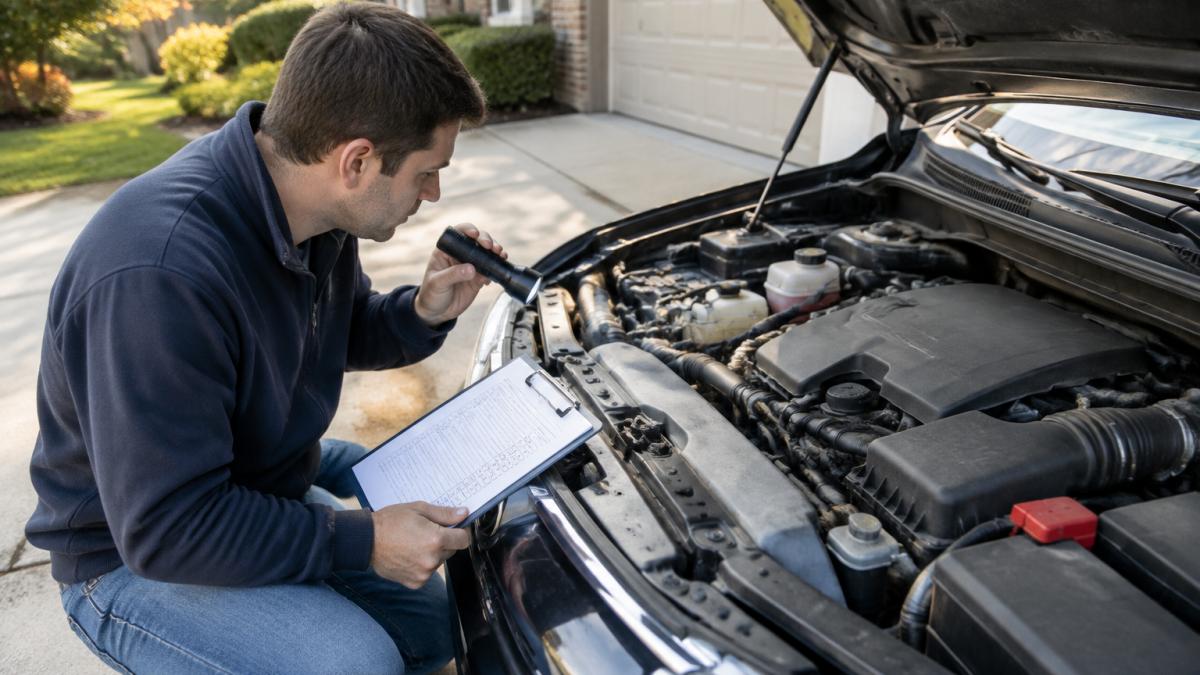
Here is the core of any used car inspection for beginners. Work through it in order and write down what you find.
For a deeper itemized list, use our 10-point used car inspection checklist alongside this section.
Cold Start, Fluids, and the OBD-II Scanner
Arrive when the engine is cold. A cold start reveals problems a warm engine hides.
- Cold start: Listen for rattles, ticking, or a rough idle.
- Exhaust smoke: Blue smoke means burning oil. White smoke can mean coolant.
- Engine oil: Pull the dipstick. Dark is normal; gritty or milky is not.
- Coolant: Check the level on a level surface. Low coolant can signal a leak.
- Serpentine belt: Look for cracks and glazing.
- OBD-II scanner: Plug it in and read the codes. A cheap scanner shows pending codes the seller may have cleared.
A check engine light that stays on is a negotiation point, not always a dealbreaker.
Tires, Brakes, and the Under-Carriage Look
- Tire tread depth: Use a gauge. Below 4/32 inch is worn.
- Uneven wear: Points to alignment or suspension problems.
- Brake pad wear: Look through the wheel spokes.
- Fluid leaks: Check for drips under the car.
- Rust corrosion: Look at the frame and rocker panels.
- Frame damage: Any crinkle or weld line is a red flag.
Bring a flashlight and get low. The under-carriage inspection is where hidden damage lives.
Work through these checks in order and write down what you find.
| Check | What to do | What it reveals |
|---|---|---|
| Cold start | Arrive with the engine cold and listen | Rattles, ticking, or rough idle |
| Exhaust smoke | Watch the exhaust on start | Blue smoke means burning oil; white can mean coolant |
| Engine oil | Pull the dipstick | Gritty or milky oil is not normal |
| Coolant | Check the level on a level surface | Low coolant can signal a leak |
| Serpentine belt | Look for cracks and glazing | Belt wear |
| OBD-II scanner | Plug it in and read the codes | Pending codes the seller may have cleared |
| Tire tread depth | Use a gauge | Below 4/32 inch is worn |
| Brakes and under-carriage | Look through wheel spokes, check for drips, rust, frame damage | Worn pads, leaks, corrosion, hidden damage |
The Test Drive: What Your Senses Catch That a Checklist Can’t
A test drive is a used car inspection tool no checklist replaces. Start the car cold, then drive for at least 15 minutes on mixed roads.
Listen and feel for:
- Transmission shifting: Should be smooth, no slipping or clunking.
- Brakes: No grinding, pulling, or soft pedal.
- Steering: No vibration or wander.
- Suspension components: Clunks over bumps mean worn parts.
- Electrical systems: Test every window, light, and the climate control.
Edmunds notes that a test drive is part of the inspection, not a separate step. Treat it that way.
When a Used Car Pre-Purchase Inspection Beats a DIY Check
A DIY check catches a lot. But it can’t replace a lift, a diagnostic scan, or a trained eye. That is the honest limit of any beginner’s inspection.
Hire a professional when:
- The car costs more than you can easily lose.
- The seller is far away and you’re buying remotely.
- The car is a classic, exotic, or heavy-duty truck.
- You spot frame damage, flood signs, or an odometer discrepancy.
Our guide on when an independent inspection is worth it covers the decision in detail, and our overview of the benefits of a professional vehicle inspection explains what a report should include.
Book Your Independent Inspection Before You Make an Offer
A used car inspection protects your money. The best time to schedule one is before you shake hands, not after. Whyte Knyte Inspection sends mobile inspectors to the vehicle, whether it sits at a dealership, a private driveway, or an auction lot.
Here is what you get:
- Zero financial interest in the car you buy, so the report favors you.
- Photo-documented reports delivered within 24-48 hours.
- Coverage in 48 states, from compact cars to heavy-duty semi trucks.
- Over 20 years of automotive experience behind every inspection.
You can book a mobile pre-purchase inspection online and have a report in hand before you make an offer.
Frequently Asked Questions
What should beginners check when inspecting a used car?
Start with a cold start so you can hear the engine before it warms up, then check engine oil condition, coolant levels, and look for fluid leaks under the car. Walk the body for rust corrosion and frame damage, measure tire tread depth, and scan for a check engine light with an OBD-II scanner. Finish with a test drive covering transmission shifting and brake pad wear. Edmunds advises having a mechanic inspect a used car before purchase, so treat your own checks as a filter, not a replacement.
Should you get a professional used car pre-purchase inspection before buying?
Yes, especially on anything expensive or bought remotely. A used car pre-purchase inspection by a professional mechanic catches frame damage, odometer discrepancy, and flood damage that a beginner’s visual check will miss. A mobile inspector who travels to the vehicle and has no financial interest in the sale can give you an independent read on the car.
How long does a used car inspection take?
A thorough DIY check takes 45 to 90 minutes, including a 15 to 20 minute test drive on mixed roads. A professional pre-purchase inspection typically runs longer because it includes a lift or under-carriage inspection and a full diagnostic scan.
What paperwork should you check when buying a used car?
Verify the VIN on the dashboard, door jamb, and title all match, and confirm the title is not a salvage title. Ask for maintenance records and a vehicle history report, and compare the odometer reading against service history for signs of rollback. At a dealership, get the buyer’s guide and any warranty terms in writing. Missing service history is not automatically a dealbreaker, but a mismatched VIN or a title that does not match the seller’s name is.
Buying a used car without an independent look is a gamble you don’t have to take. Whyte Knyte Inspection gives you a clear, photo-backed report so you can walk away from hidden damage or negotiate with real leverage. Get started with Whyte Knyte Inspection and make your next vehicle purchase with confidence.
